

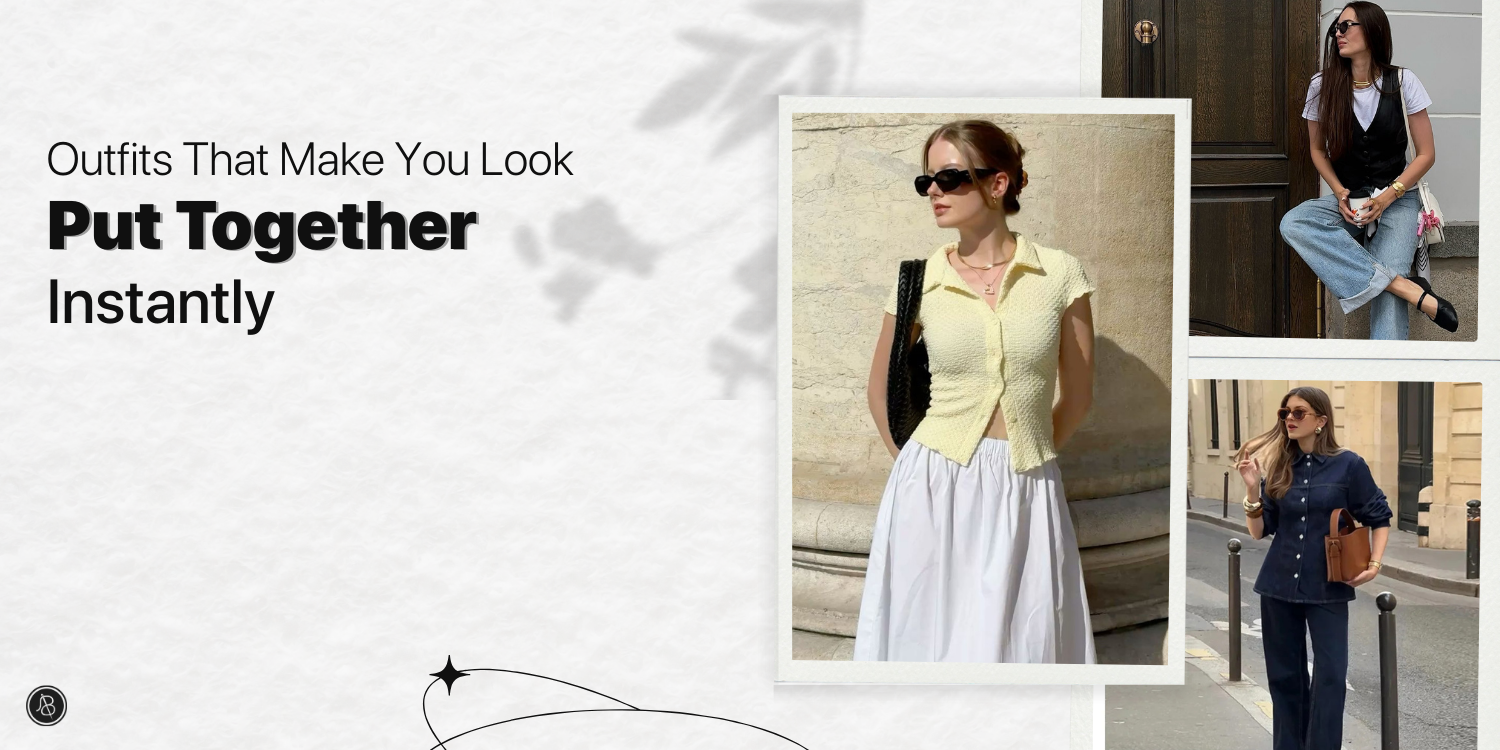
There are days when you want to look good without thinking. We’re talking zero Pinterest spirals. No trying on ten different outfits only to end up in sweatpants. No standing in front of the mirror asking the universe, “Why does nothing work on me?”
We have all been there. The closet is full, yet the inspiration is empty.
But here is the secret that the most stylish people know: Looking put together is not about dressing up. It’s not about wearing a gown to the grocery store or a three-piece suit to a coffee run. It’s about wearing outfits that feel intentional, even when they took exactly five minutes to put on.
It is about the subtle art of looking like you tried, without actually trying too hard.
This blog breaks down the specific outfit formulas that consistently work. It doesn't matter your style, your body type, or your mood. These are the universal truths of looking polished. If you master these principles, you will never have a "nothing to wear" meltdown again.
Every put-together outfit starts with a strong foundation. Think of it like building a house. If the foundation is shaky, it doesn't matter how nice the curtains are; the house is going to feel unstable.
In fashion, your "base" is the core of your outfit. It can be jeans and a tee, a co-ord set, or a simple dress.
What matters is not the brand or the price tag. What matters is that the base is:
A plain white tee with straight-leg jeans already looks intentional if the fit is right. The moment clothes sit properly on your body, the outfit stops looking accidental.
Let's break down the "Jeans and Tee" base. It sounds boring, right? But picture this:
Same items. Completely different vibe. Scenario B looks polished. Scenario A looks like you just rolled out of bed.
If you ever feel underdressed or sloppy, fix the base first. Don't try to add a jacket or jewelry to distract from a bad base. It won't work.
Start with the essentials. Do your jeans fit your waist perfectly? Does the shoulder seam of your t-shirt actually sit on your shoulder? These tiny details are the difference between "clothes" and an "outfit." When the base is solid, you are already 80% of the way there.
Structure is the magic ingredient that separates "lazy" from "effortless."
We love comfort. We love soft fabrics. But an outfit entirely made of soft, unstructured things (leggings, hoodies, slouchy tees) often reads as loungewear. To elevate it, you need to introduce some architecture.
Add just one structured element, and the outfit immediately looks styled.
This could be:
Even over casual clothes, structure adds polish. It creates a visual boundary. It tells people, "I planned this," even if you didn't.
Take a grey hoodie and leggings. Comfortable? Yes. Stylish? Maybe not on its own. Now, throw a structured, oversized camel coat over it. Suddenly, you look like an off-duty model running errands in SoHo.
Take a simple slip dress. It’s soft and fluid. Add an oversized menswear blazer on top. Now you have a silhouette that is interesting, balanced, and undeniably cool.
Collars are structure. Cuffs are structure. A waistband is structure.
This is why a button-down shirt tucked into sweatpants (yes, really) can look cool, while a t-shirt tucked into sweatpants just looks like gym clothes. The collar frames the face and adds a sharp line to the softness.
If you feel like your outfit is too "mushy" or undefined, add a piece with corners, lapels, or distinct lines. It tightens the whole look instantly.
Color matching is hard. Mixing prints is even harder. If you are in a rush, or if you just want to guarantee you look good, neutrals are your safety net.
Neutral outfits almost never look messy.
We are talking about:
These colors naturally sit well together. They are quieter to the eye. They don't fight for attention. Because they are visually calm, the brain perceives them as organized and sophisticated.
When colors don’t fight for attention, the outfit feels expensive and composed.
One of the easiest ways to look put together is to go monochromatic. Wear all black. Wear all cream. Wear all navy.
An all-black outfit—black turtleneck, black trousers, black boots—looks incredibly chic, even if the pieces are from a fast-fashion store. Why? Because it creates a long, unbroken vertical line that lengthens the body and minimizes visual clutter.
You don't need to dress like a beige aesthetic influencer every day. You can love color. But if you want to look polished instantly, anchor your outfit with one or two neutrals.
If you are wearing bright red pants, pair them with a crisp white shirt or a black sweater. Avoid pairing them with a purple top and green shoes unless you are extremely confident in your color theory.
Neutrals act as a palette cleanser. They give the eye a place to rest, making the overall appearance feel curated rather than chaotic.
If you want to look put together with zero mental effort, matching sets are your best friend.
Seriously. They are the ultimate cheat code.
Why do they work? Because matching sets instantly look intentional. The work is already done for you. The colors match perfectly. The fabrics coordinate. The silhouettes are designed to go together.
Matching sets remove the biggest problem in dressing: deciding what goes with what.
You don't have to stand there holding a top and wondering, "Does this go with these pants?" The answer is yes. It was literally made to go with those pants.
It creates a cohesive, uniform look that reads as high-effort, even though it is actually the lowest effort possible. You are essentially wearing adult onesies, but because they match, it looks like Fashion with a capital F.
The danger with sets (especially knit or sweat sets) is looking too casual. The fix is in the styling.
If you are wearing a matching grey sweat suit:
If you are wearing a linen co-ord:
Throw on clean shoes and a bag, and you are done. It takes 30 seconds to get dressed, but you look like you have a personal stylist.
You can wear a perfectly tailored suit, but if you wear dirty, beat-up running shoes with it, the look falls apart.
Shoes have the power to upgrade or ruin an outfit in seconds. They are the punctuation mark at the end of the sentence.
There is a styling trick called the "Wrong Shoe Theory," where you wear the shoe that feels slightly unexpected. A dress with sneakers. Jeans with a satin heel. Trousers with a flip-flop.
But for the purpose of looking put together instantly and easily, we focus on the Condition and Style of the shoe.
Over-worn, scuffed, muddy, or mismatched shoes pull everything down. They signal neglect.
If you want a quick hack to look taller and sharper: wear a pointed toe. Whether it’s a flat, a boot, or a heel, a pointed toe elongates the leg line and looks more aggressive and "business" than a round toe.
If you ever feel like an outfit isn’t working, look down. The answer is usually there. Swap the muddy trainers for a clean loafer or a sleek boot, and watch the entire outfit transform.
There is a misconception that "styling" means adding more stuff. More necklaces. A hat. A scarf. A belt. A bag charm.
But looking put together is often about editing, not adding. It is not about stacking accessories until you rattle when you walk. It’s about choosing the right ones.
One strong accessory is enough.
Accessories are the polish. They signal that you took that extra 10 seconds to complete the look.
Imagine a white tee and jeans. Fine.
Now imagine a white tee, jeans, a leather belt, and gold hoop earrings. Better.
The belt creates a visual break. The earrings add light near the face.
Avoid the Clutter
When accessories are intentional, the outfit feels finished. When there are too many, it feels chaotic.
If you are wearing big statement earrings, skip the necklace. If you are wearing a stack of bracelets, keep the rings simple.
Minimal always reads more confident. It says, "I don't need to hide behind clutter." A simple, cohesive look allows you to wear the clothes, rather than the clothes wearing you.
This is the invisible element of style. You can wear a $5,000 designer outfit, but if your hair is greasy and your nails are chipped, you won't look put together.
Conversely, you can wear a $20 outfit from a thrift store, but if your grooming is on point, you will look expensive.
Grooming is part of the outfit. It is actually the most important accessory you own.
Simple grooming choices make a massive difference:
This doesn’t mean high maintenance. It means intentional. It means taking care of the canvas before you put the paint on.
When you look fresh, your clothes look fresher. If you are running late and have to choose between elaborate makeup or steaming your shirt... steam the shirt and put on sunglasses. Wrinkles (on clothes) are the enemy of polish.
The biggest myth in fashion is that stylish people are constantly reinventing the wheel. They aren't.
The most put-together people—the Anna Wintours, the Victoria Beckhams, the cool girl on Instagram you admire—are repeaters. They repeat outfits that work for them. Constantly.
They know their silhouettes. They know their colors. They have formulas.
They don't wake up and panic. They wake up and think, "It's a Tuesday, I'm feeling bloated, I have a meeting. I'll wear Formula #3: The Wide Leg Trouser and the Oversized Knit."
They tweak, they don't reinvent.
Think of your closet like a menu at a restaurant. You don't need infinite options. You need a few signature dishes that are guaranteed to be delicious.
Once you find combinations that make you feel confident—maybe it's a blazer and straight jeans, maybe it's a midi skirt and a turtleneck—save them. Take a picture of yourself in the mirror. Save it to a "My Outfits" album on your phone.
Next time you are rushing, open that album. Pick a look. Put it on.
Stop doubting yourself. Stop thinking you can't wear the same thing twice in a week. You can. It's called having a signature style.
Style gets easier when decisions are already made.
Why do we care about looking put together? Is it vanity?
Not really. It’s about cognitive load.
When you look in the mirror and see a cohesive, polished image, your brain relaxes. You stop worrying about your appearance. You stop tugging at your hemline. You stop wondering if people are judging your mismatched socks.
You feel secure. And when you feel secure, you act with more confidence. You walk taller. You speak more clearly. You engage with the world differently.
The outfit is just a tool to get you to that mental state.
Let's recap the cheat sheet for those mornings when your brain is offline:
You don't need a new wardrobe to look better. You likely have everything you need right now. It's just about combining them with a little more strategy and a little less chaos.
Looking put together instantly isn’t about trends. It isn't about shopping every weekend. It definitely isn't about perfection.
It’s about intentionality.
It’s about clean basics.
It’s about one strong element.
It’s about balanced colors.
It’s about details.
When your outfit feels calm and considered, you look confident without trying. You signal to the world—and to yourself—that you have your life handled (even if, on the inside, you're just figuring it out like the rest of us).
And really, isn't that the goal? To look like the person we want to be, until we actually become her.
So tomorrow morning, don't overthink it. Grab the jeans. Grab the white tee. Throw on the blazer. Clean your sneakers.
You look great. Now go handle your day.
Before we wrap up, we have to talk about one tiny physical adjustment that changes everything: The Tuck.
You have your base (jeans and tee). You have your structure (blazer). But the tee is hanging long and loose over the jeans, cutting your body in half at a weird spot.
Tuck it in.
Experiment with tucking. Often, an outfit looks "frumpy" simply because the proportions are off. Tucking restores the rule of thirds (one-third torso, two-thirds legs), which is visually pleasing to the human eye.
Another layer to looking put together is fabric choice.
Cheap, thin, synthetic fabrics that cling with static or wrinkle easily are hard to style. They fight against you.
Natural fibers like cotton, linen, wool, and silk tend to drape better. They hold their shape. Even a thick, heavyweight cotton t-shirt looks significantly more "expensive" than a thin, sheer one.
When buying basics, touch the fabric. Does it feel substantial? Does it bounce back when you scrunch it? Investing in slightly better fabrics for your core items (your base) makes the "instant put together" look much easier to achieve.
Stylists often talk about the "Third Piece Rule."
Your pants and shirt are clothes. The third piece makes it an outfit.
The third piece can be a jacket. It can be a sweater draped over your shoulders (very preppy-chic). It can be a statement belt. It can be a hat.
If you look in the mirror and feel boring, ask: "Where is my third piece?"
Adding that third layer creates depth. It adds texture. It shows complexity. It is a visual cue that you didn't just get dressed; you styled yourself.
We touched on this earlier, but it deserves its own spotlight.
If you have 5 minutes to get ready for a dinner, a date, or a meeting, and you are panicking: wear all black.
Black absorbs light. It hides wrinkles. It hides cheap fabric. It hides stains. It creates a sleek silhouette. It is the ultimate panic button.
But make sure the blacks match (don't mix a faded grey-black tee with jet-black pants) and play with texture. A black leather jacket with black denim jeans and a black silk camisole is incredibly interesting because of the mix of leather, denim, and silk.
Finally, remember that the most stylish thing you can wear is an attitude of non-chalance.
If you are constantly pulling at your skirt, adjusting your straps, or checking your reflection, you look uncomfortable. And discomfort breaks the illusion of being put together.
Wear clothes that fit you right now, not the body you plan to have in three months. Wear shoes you can actually walk in.
When you are physically comfortable, you look at ease. And looking at ease is the definition of chic.
So, curate your formulas. Steam your clothes. Put on the earrings. And then forget about it. The best outfits are the ones you put on and never think about again for the rest of the day.
You’ve got this. Now go get dressed.