How AI Personal Stylists Work (And What They Get Right) | BeSpoke AI Stylist
Published · Updated
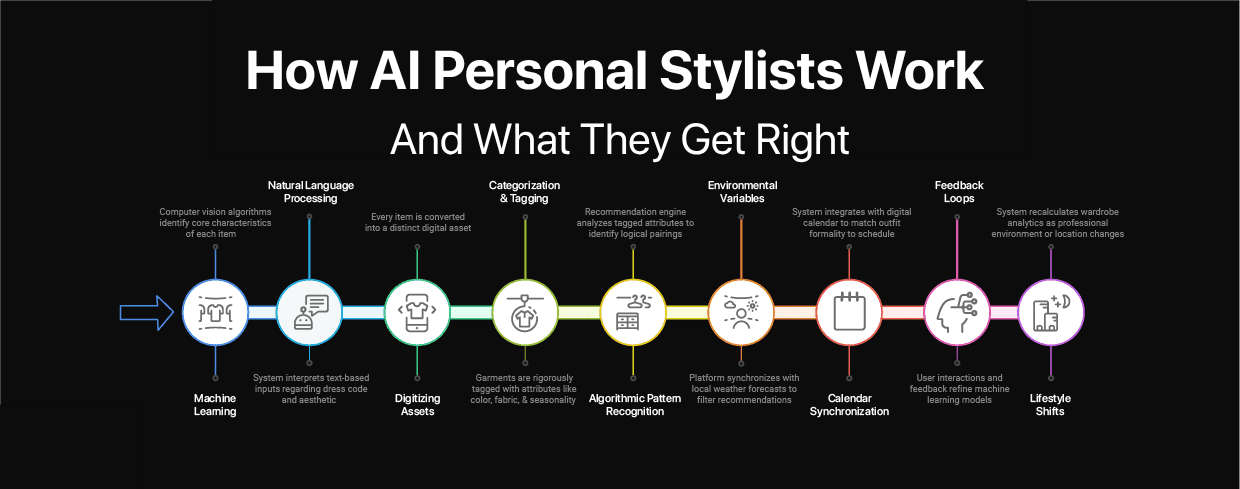
How AI Personal Stylists Actually Work
By Neeraj Bansal, Founder and CEO, BeSpoke AI Stylist
"AI stylist" sounds like a vague buzzword until you break down what's actually happening behind it. It isn't a magic algorithm guessing your taste from thin air. It's a fairly straightforward system: your wardrobe, your context, and a set of styling rules, combined to remove the guesswork from getting dressed.
Here's exactly what that looks like in practice, and why it works.
Step One: It Starts With What You Actually Own
An AI stylist can only be as useful as the wardrobe data it has to work with. That's why the first step is always building a digital closet, photographing your clothes so the app has a real, searchable record of what you own, sorted by category, color, and type.
This is the part that separates an AI stylist from a generic fashion inspiration feed. A Pinterest board can show you a beautiful outfit you don't own. An AI stylist can only suggest combinations that exist, right now, in your actual closet.
Step Two: It Reads Context, Not Just Clothes
Once your wardrobe is digitized, the system layers context on top of it:
Weather: pulling a real forecast so you're not suggested a linen dress on a cold, rainy day
Occasion: a work meeting, a casual weekend, a night out, a wedding
Calendar: matching outfits to what's actually on your schedule
Past choices: noticing what you've worn recently so you're not stuck repeating the same three outfits while the rest of your closet sits untouched
This is the "data, not trends" idea in practice. Instead of pushing whatever's currently popular on runways, the system is working from your actual clothes and your actual week.
Step Three: It Generates Real, Wearable Combinations
From there, the app builds full outfit suggestions using pattern logic, similar to how a human stylist thinks about proportion, color pairing, and layering, but applied instantly across your entire digital closet instead of whatever a person could recall from memory.
You can save the outfits you like, tweak individual pieces, or ask for alternatives. Over time, the suggestions get sharper because the system has more data about what you actually choose to wear versus what you skip
What This Actually Solves
Decision fatigue. Every small choice while getting dressed, what's clean, what matches, what fits the day, pulls from the same limited mental energy you need for everything else. An AI stylist absorbs that decision instead of you making it fresh each morning.
Underused wardrobe. Most people wear a small fraction of what they own on repeat. Surfacing forgotten pieces through outfit suggestions is one of the most immediate, practical benefits.
Shopping regret. Because the system knows your existing wardrobe, it can flag when something you're about to buy duplicates what you already have, or genuinely fills a gap.
Where This Genuinely Helps vs. Where It Doesn't Replace a Human
An AI stylist is excellent at speed, consistency, and using 100% of your actual wardrobe rather than the 20% you remember. It's less suited to nuanced, one-off decisions, like advising on a major style overhaul or reading subtle social context a human stylist would pick up on instinctively.
For daily outfit planning, working with what you already own, and cutting decision time from fifteen minutes to a few seconds, this is exactly the kind of repetitive, data-driven task AI is built for. If you're curious how it stacks up point-by-point against hiring an actual human stylist, that's covered in a separate breakdown: AI vs Human Stylist.
Frequently Asked Questions
Does an AI stylist only recommend clothes I need to buy?
No, the opposite. A well-built AI stylist works primarily from your existing wardrobe, and only recommends new purchases where there's a genuine gap.
How does it know what actually suits me?
By combining your digital wardrobe with pattern logic around color, fit, and proportion, and by learning from which suggestions you actually choose to wear over time.
Is AI styling only useful for people who already have a big wardrobe?
No. It works with whatever you have, even a partial closet, and gets more useful as you add more.
Can it replace a professional stylist entirely?
For daily outfit decisions, yes for most people. For big-picture style direction or major wardrobe overhauls, many people still value a human's judgment. It's less either/or and more about which tool fits which decision.
Ready to let an AI stylist work from your actual closet instead of guesswork? Download BeSpoke AI Stylist on the App Store or Play Store.
Ready to upgrade your style game? Download BeSpoke AI Stylist and let your AI stylist take it from here.

Author
Neeraj Bansal