Skin Tone vs Undertone: How to Find Your Undertone
Published · Updated
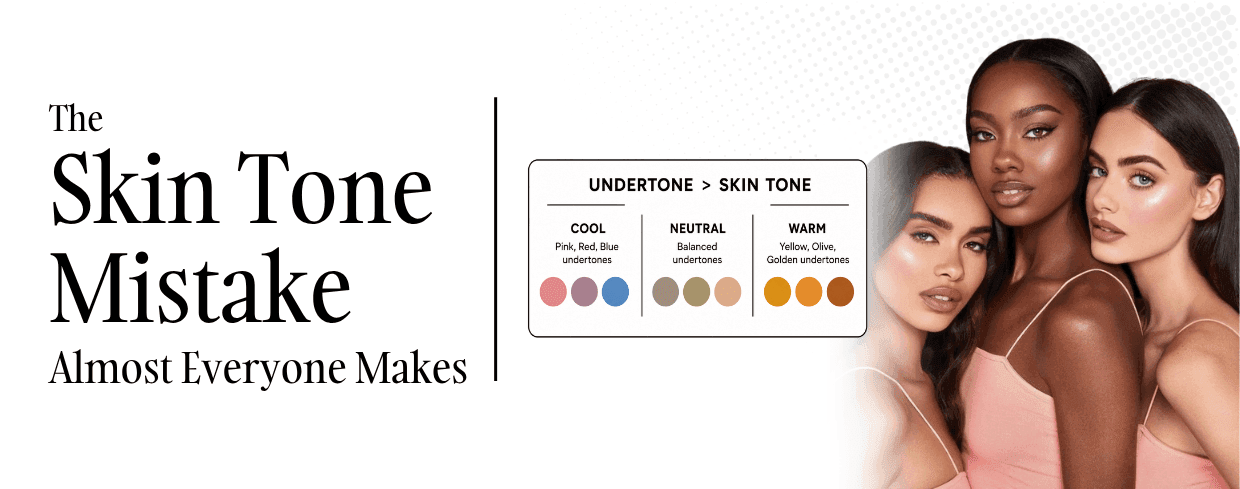
Most people can describe their skin as fair, medium, or deep within seconds. Ask them about their undertone, and the confidence disappears. This one gap in understanding is responsible for more wardrobe mismatches, unflattering makeup shades, and "why does this color look off on me" moments than almost any other styling factor.
Skin tone and undertone are not the same thing, and confusing the two is the single most common mistake people make when trying to figure out what colors actually work for them. This guide breaks down exactly what undertones are, how to identify yours accurately, and why getting this right changes everything from your wardrobe to your jewelry drawer.
Chart showing warm, neutral, and cool undertones across fair, light, medium, and dark skin tones
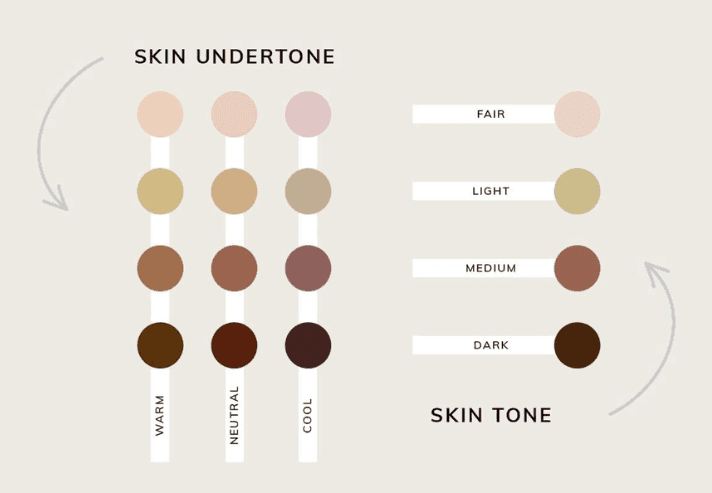
Skin tone refers to the surface color of your skin, how light or deep it appears. This can change with sun exposure, seasons, and even skincare routines. Undertone, on the other hand, is the subtle hue beneath the surface of your skin. It is permanent and does not change regardless of tan lines, foundation shade, or time of year.
This distinction is exactly where most people go wrong. Someone with fair skin can have a warm undertone, just as someone with deep skin can have a cool one. Undertone has nothing to do with how light or dark your skin appears, which is precisely why relying on skin tone alone leads to so many mismatched color choices.
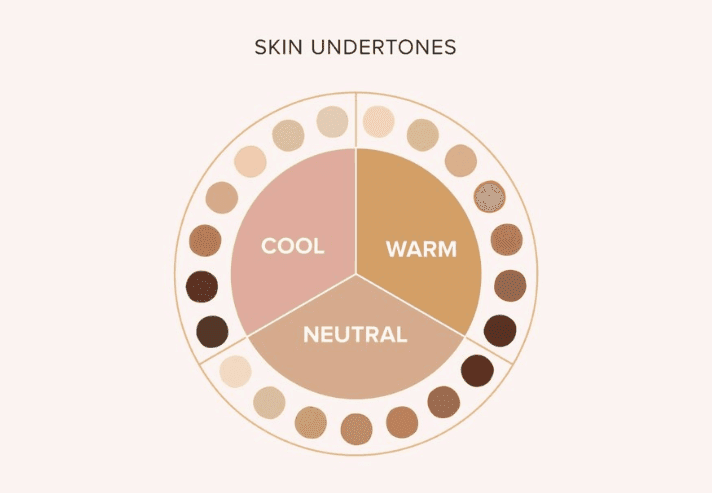
Circular skin undertone chart divided into cool, warm, and neutral categories with surrounding skin tone swatches
Warm Undertones
Warm undertones carry hints of yellow, peachy, or golden hues beneath the skin. People with warm undertones often find that earthy colors, golds, and warm neutrals bring out a natural glow, while overly cool or icy shades can make their complexion look washed out.
Cool Undertones
Cool undertones lean toward pink, red, or bluish hues. Silver jewelry, jewel tones, and cooler neutrals tend to complement cool undertones particularly well, while very warm, golden shades can sometimes clash or overpower the complexion.
Neutral Undertones
Neutral undertones sit right in the middle, carrying a balanced mix of warm and cool hues. This is often considered the most flexible undertone category, since both warm and cool colors can work well, though usually not at their most extreme.
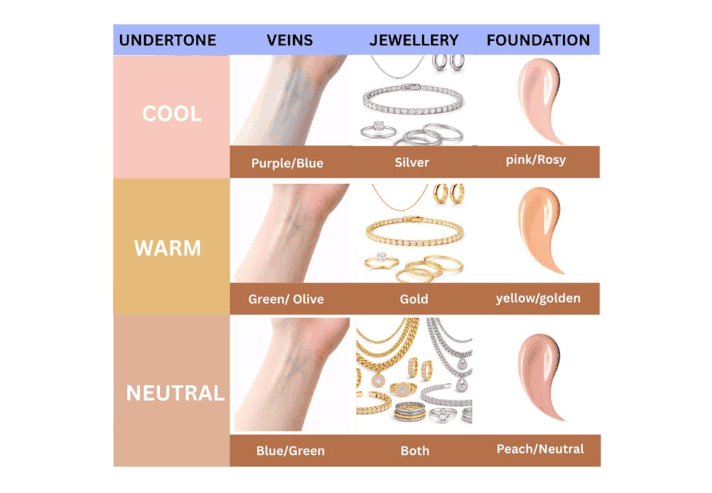
Undertone test chart comparing vein color, jewelry metals, and foundation shades for cool, warm, and neutral undertones
The Vein Test
One of the most commonly cited methods involves checking the veins on your inner wrist in natural light. Greenish veins typically suggest a warm undertone, while bluish or purplish veins point toward cool. Veins that appear to be a mix of both, or hard to categorize, often indicate a neutral undertone.
This test is a helpful starting point, but it is not foolproof on its own, which is why it is worth combining with at least one other method for a more accurate read.
The Jewelry Test
Gold versus silver is one of the most reliable visual tests for undertone. Holding both gold and silver jewelry against your skin in natural light often makes the difference obvious almost immediately. If gold makes your skin look brighter and more radiant, that typically points to a warm undertone. If silver does the same, cool is more likely. If both look equally flattering, neutral is probably your category.
The White vs Cream Test
Try holding a pure white fabric next to a cream or ivory fabric close to your face. If the pure white makes your complexion look brighter and more even, that often signals a cool undertone. If the cream or ivory shade is more flattering, warm is the likely answer.
Sun Reaction
How your skin reacts to sun exposure can also offer clues. Skin that tans easily and rarely burns often leans warm, while skin that burns before it tans tends to lean cool. This method is not always definitive on its own, but combined with the tests above, it adds another useful data point.
Side-by-side comparison of a Reese Witherspoon wearing dark green and teal dresses to show how clothing colors affect the complexion
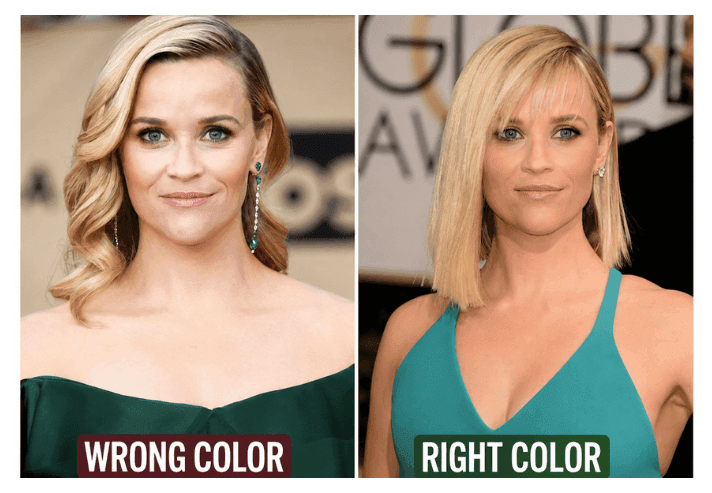
Wardrobe Choices That Actually Work
Once undertone is correctly identified, choosing clothing colors becomes significantly easier. Instead of guessing or relying on trends, you can build a wardrobe around shades that are already known to complement your complexion. This does not mean avoiding certain colors altogether, but rather understanding which version of a color works best. A cool undertone might gravitate toward a berry red, while a warm undertone might find a tomato or brick red far more flattering.
Makeup That Matches Instead of Fights
Foundation shade matching is one of the most frustrating beauty experiences precisely because undertone is so often ignored. A foundation that matches skin tone in depth but not in undertone will almost always look slightly off, either too ashy or too orange. Understanding undertone eliminates a huge amount of the guesswork involved in finding the right shade.
Jewelry That Elevates Instead of Competes
As the jewelry test demonstrates, gold and silver do not work equally well on everyone, and this is entirely tied to undertone rather than personal preference alone. Choosing metals that align with your undertone means jewelry consistently enhances your complexion rather than occasionally clashing with it.
Infographic comparing warm, neutral, and cool undertones using skin hue, vein color, and reaction to sun exposure
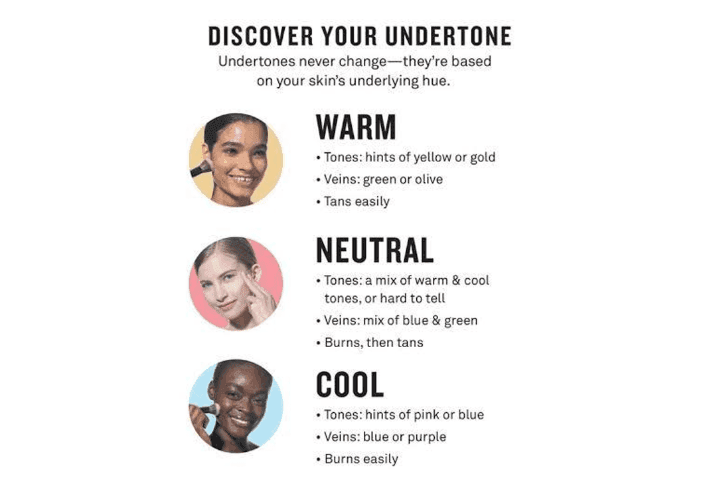
"Undertone Changes With a Tan"
A tan changes skin tone, not undertone. The hue beneath the skin remains the same regardless of sun exposure, which is why undertone is considered a fixed, reliable factor for color matching, unlike overall skin tone, which fluctuates seasonally.
"Fair Skin Means Cool Undertone"
This is one of the most persistent misconceptions, and it is simply not accurate. Undertone is independent of how light or deep skin appears. Fair skin can be warm, cool, or neutral, just as deep skin can fall into any of the three categories.
"You Can Only Wear Colors That Match Your Undertone"
Undertone is a guide, not a restriction. Almost any color can be worn by anyone, the key difference lies in choosing the right shade or version of that color. A cool-toned person is not banned from wearing yellow, they simply might lean toward a lemon or icy yellow rather than a golden mustard.
Woman comparing color swatches and palette cards on a table during a personal color analysis

Understanding your undertone is not just about picking the right lipstick or blouse color. It becomes a foundational piece of building a wardrobe that consistently works, rather than one built on trial and error. When undertone-informed choices are combined with fit and personal style preferences, outfits tend to come together with far less effort and far more consistency.
This is exactly where digital styling tools can make the process significantly easier. Instead of manually cross-referencing every new item against your undertone, AI-powered styling can factor this information in automatically, helping surface color combinations and pieces that are already aligned with what suits you.
Can undertone change over time? No, undertone remains consistent throughout life. What can change is skin tone, due to factors like sun exposure or seasonal variation, but the underlying hue does not shift.
What if my tests give conflicting results? This is common and usually points toward a neutral undertone, which typically shows mixed or inconclusive results across different tests since neutral undertones balance both warm and cool qualities.
Does undertone affect hair color choices too? Yes, undertone plays a significant role in hair color selection as well, which is why colorists often ask about skin undertone before recommending shades.
Is it possible to have different undertones on different parts of the body? Undertone is generally consistent throughout the body, though slight variations in perceived tone can occur due to differences in sun exposure across areas.
Undertone is the missing piece behind most color related styling frustrations, and once identified correctly, it becomes one of the most useful tools for building a wardrobe, makeup routine, and jewelry collection that consistently works. The difference between a color that flatters and one that falls flat often comes down to this single, permanent characteristic.
Ready to build a wardrobe that works with your undertone, not against it? Explore your personalized color palette with BeSpoke AI Stylist.
Sources and Further Reading
International Commission on Illumination: Perceived Colour- https://cie.co.at/eilvterm/17-22-040
U.S. Food and Drug Administration: The Risks of Tanning- https://www.fda.gov/radiation-emitting-products/tanning/risks-tanning
Clothing Aesthetics: Consistent Colour Choices to Match Fair and Tanned Skin Tones- https://pmc.ncbi.nlm.nih.gov/articles/PMC8597069/
A Mobile Application for Personal Colour Analysis- https://doi.org/10.1080/23311975.2019.1576828
Ready to upgrade your style game? Download BeSpoke AI Stylist and let your AI stylist take it from here.

Author
Neeraj Bansal