
How to Identify Real Ikat Fabric vs Ikat Print
Published · Updated
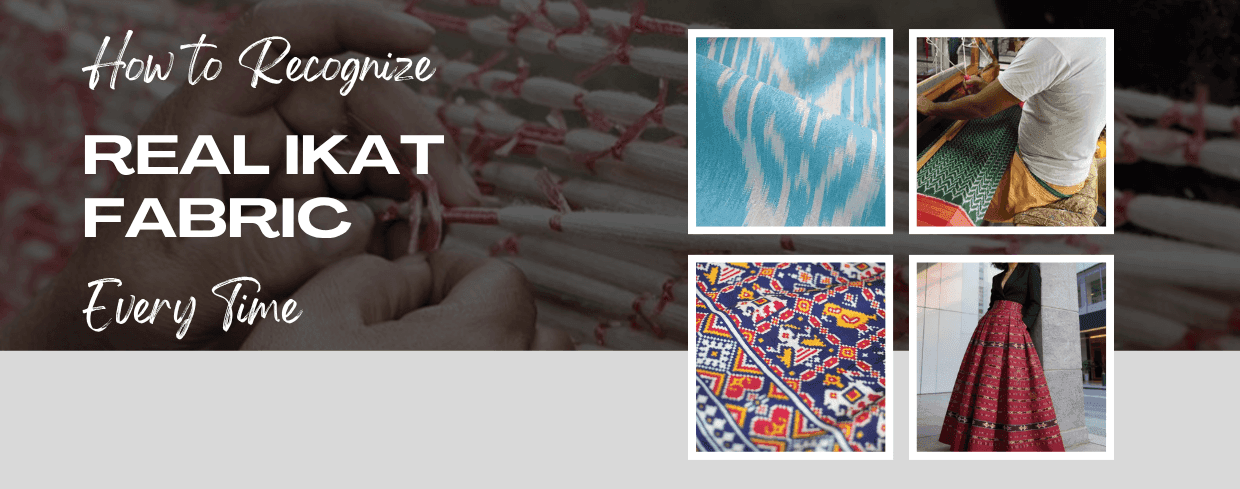
Scroll through any fashion feed today and you will see the word Ikat everywhere, printed on sundresses, cushion covers, and even sneakers. But most of what gets called Ikat online is a printed imitation, not the real, hand-tied and hand-woven textile that gives the fabric its name. If you have ever held up a piece of fabric in a store and wondered whether it is genuine Ikat or just a clever print, this guide will teach you exactly what to look for, in seconds, every single time.
What Makes Ikat Different From Printed Fabric
The most important thing to understand about Ikat is that it is a weaving technique, not a pattern style. A printed fabric starts as plain, undyed cloth. The design is then stamped, screen printed, or digitally printed onto the surface after the fabric is already woven. Ikat works the opposite way. The pattern is built into the yarn itself, long before a single thread touches the loom.
This distinction matters because it changes how the fabric behaves and how much it is worth. A printed imitation will show the same crisp, flat pattern on both sides or fade unevenly with washing. Authentic Ikat carries its design through the entire thickness of the yarn, which is why the pattern survives decades of wear in heirloom sarees and dupattas.
How to Identify Real Ikat Fabric at a Glance
- Edge check: Soft, feathered motif edges are common in Ikat, but they are a clue rather than proof.
- Reverse-side check: The pattern is usually visible on both faces of woven Ikat, although the two sides may not look identical.
- Yarn check: Look closely for colour changes within the warp or weft yarns instead of a design that appears to sit only on the fabric’s surface.
- Maker check: Ask where the textile was woven, which yarns were resist-dyed and what supports any handwoven or GI claim.
- Cross-check: Use several signs together. Price, blurred edges or a product label alone cannot confirm authenticity.
Close-up views of blue Ikat fabrics showing soft, feathered motif edges
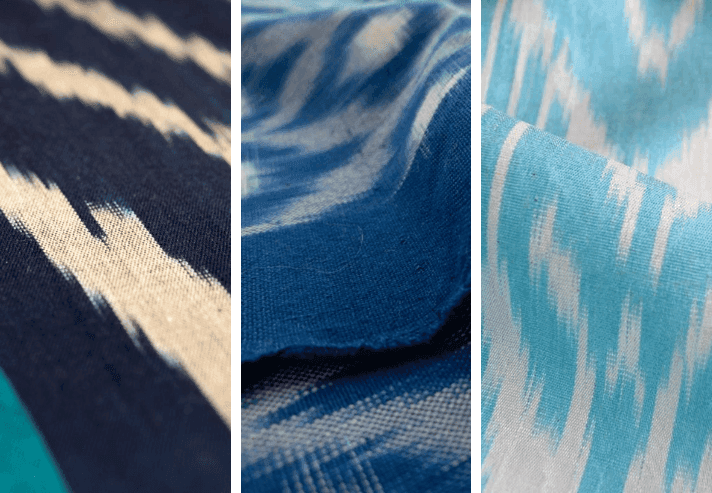
Here is the fastest way to identify Ikat without needing to touch the fabric or ask the shopkeeper a single question. Look closely at the edges of the motifs. In a printed fabric, every edge is sharp, clean, and perfectly defined, because a machine or screen is stamping an exact shape.
In real Ikat, the edges of each motif have a soft, slightly feathered or blurred quality. This is not a flaw. It is the fingerprint of the technique, and it is impossible to fake convincingly. That subtle blur happens because of how the yarn is dyed before weaving, and no amount of digital printing has managed to replicate it with full accuracy. If you remember only one identification trick from this entire guide, remember this one: blurred edges mean real Ikat.
Designers who work with the fabric often say this blur gives Ikat its movement. A printed pattern sits still on the cloth. Woven Ikat seems to shift and breathe with the body, because the pattern is part of the yarn's structure rather than a layer on top of it.
Artisans dyeing tied yarn, binding yarn bundles and weaving Ikat on a handloom
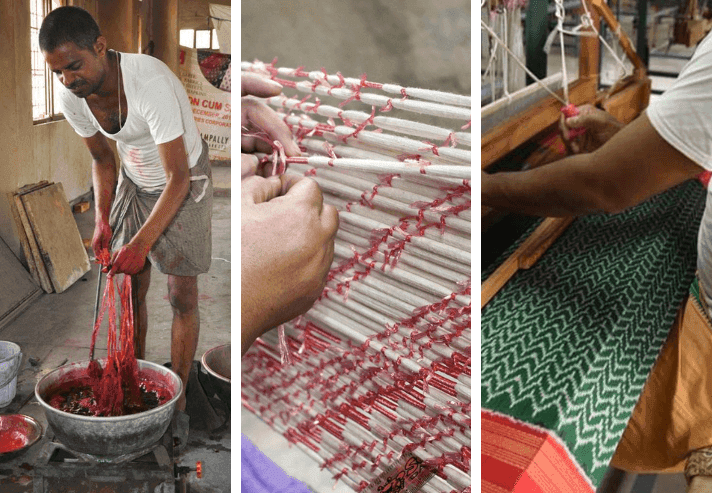
Understanding how Ikat is made explains why it looks the way it does. The process happens in three deliberate stages, and skilled artisans plan the entire final pattern before a single thread is dyed.
Step one is tying. Bundles of yarn are wrapped tightly with waterproof material, usually rubber strips or waxed thread, in a specific sequence that maps out the future design. Wherever the yarn is tied, the dye will not be able to penetrate.
Step two is dyeing. The tied bundles go into a dye bath. Only the exposed sections of yarn absorb color, while the tied sections stay their original shade. For multicolored Ikat, this tie-and-dye cycle repeats several times, with artisans retying and redyeing sections to build up layers of color.
Step three is weaving. Once dyeing is complete, the ties are removed and the pre-patterned yarn goes onto the loom. This step requires the most skill, because the weaver has to align the dyed yarn with incredible precision so the pattern emerges correctly across the fabric. A slight misalignment during weaving is exactly what produces that characteristic soft blur along the motif edges.
This is also why hand-woven Ikat takes weeks, sometimes months, to produce a single length of fabric, and why it costs meaningfully more than a printed lookalike.
Three Ikat textiles in red, indigo and multicoloured geometric patterns
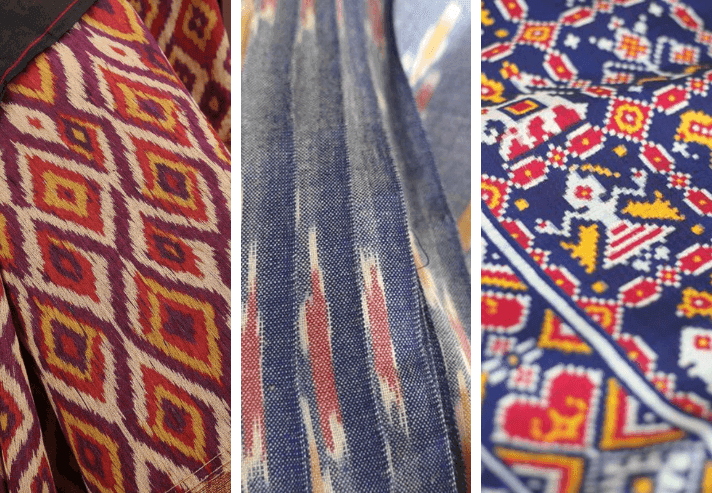
Not all Ikat is made the same way. Depending on which set of yarns gets the tie-dye treatment, weavers categorize the fabric into three distinct types.
Warp Ikat
In warp Ikat, only the warp yarns, the threads running lengthwise on the loom, are tied and dyed before weaving. The weft yarns, which run horizontally, stay a single solid color. Because only one set of threads carries the pattern, the motifs in warp Ikat tend to look slightly more elongated and the blur effect is usually more pronounced along the vertical direction. This is the most common and generally the most affordable type of Ikat, widely produced in regions like Odisha and parts of Andhra Pradesh.
Weft Ikat
Weft Ikat flips the process. Here, the weft yarns, the horizontal threads, are the ones tied and dyed, while the warp stays solid. Weft Ikat generally demands more skill from the weaver, because aligning horizontal patterned yarn correctly during the actual weaving process is technically harder than aligning a fixed vertical warp. The patterns often appear slightly crisper than warp Ikat, though the signature blur is still present.
Double Ikat
Double Ikat is the most complex and most prized version of the technique. Both the warp and weft yarns are individually tied, dyed, and pre-patterned before weaving, and the weaver must align both sets with extraordinary precision so the final design forms correctly at every intersection. This is painstaking, slow work, and true double Ikat is produced in only a handful of places in the world, most famously in Patan, Gujarat, where it is known as Patola, and in parts of Indonesia and Japan. A genuine double Ikat piece can take close to a year to complete and is priced accordingly, often treated as an heirloom rather than an everyday garment.
Ikat is not a single regional craft. It has parallel histories across India, Southeast Asia, Central Asia, and Latin America, each with its own name and variations, but India remains one of the strongest living centers of the tradition. Pochampally in Telangana is famous for its geometric warp and weft Ikat, often called Pochampally Ikat or Chitki, and the town has earned a Geographical Indication tag for its work. Odisha produces Ikat known locally as Bandha, recognizable by its curvilinear, almost painterly motifs, including the temple-inspired designs seen in Sambalpuri sarees. Patan Patola in Gujarat represents the pinnacle of double Ikat craftsmanship in India, historically worn by royal families.
Knowing the regional origin of a piece helps you understand what you are paying for and helps you spot fakes, since certain motifs and color combinations are strongly tied to specific weaving clusters.
Contemporary Ikat outfits in black, blue and red styled with simple separates

Ikat is already a statement fabric, which means the rest of an outfit needs to work with it rather than against it. The pattern carries enough visual energy on its own, so pairing it with another busy print usually competes for attention instead of complementing it.
The simplest styling rule is to let Ikat lead and keep everything else quiet. Solid colored bottoms, a plain blouse, or a neutral-toned dupatta let the weave take center stage. Pull one color directly from the Ikat pattern and use it as a solid elsewhere in the outfit, for example matching a plain kurta to the base color of an Ikat dupatta, to tie the look together without adding visual noise.
Accessories deserve the same restraint. A few well-chosen pieces, like simple gold jhumkas or a single statement cuff, will read as intentional. A full set of heavily embellished jewelry on top of an Ikat pattern tends to overwhelm the fabric's natural texture and blur effect, which is really the whole point of wearing it in the first place.
For anyone experimenting with Ikat for the first time, starting with a smaller accessory, a stole, a bag, or a cushion cover, is a low-commitment way to get comfortable with the print before moving into a full garment.
Common Mistakes When Buying "Ikat"
A few mistakes come up again and again when shopping for genuine Ikat.
The first is trusting the label alone. Many mass-market retailers use "Ikat print" as a catch-all marketing term for anything with a slightly irregular, tie-dye-adjacent pattern, even when the fabric was digitally printed from start to finish. Always check the fine print, since retailers legally have to distinguish between "Ikat print" and "handwoven Ikat," and the wording difference is a strong clue.
The second mistake is judging authenticity by price alone. Handwoven Ikat is genuinely more expensive due to the labor involved, but a high price tag does not automatically guarantee authenticity. Fall back on the visual test, checking for that soft, blurred motif edge, rather than trusting cost as a shortcut.
The third mistake is skipping the reverse side check. On printed fabric, the back usually looks noticeably paler or blank compared to the front. On woven Ikat, since the color comes from the dyed yarn rather than a surface layer, the pattern stays visible, though slightly softer, on both sides.
Why Ikat Deserves a Permanent Place in Your Wardrobe
Beyond the craft story, Ikat earns its spot in a modern closet for practical reasons too. The fabric is versatile across seasons and occasions in a way few prints manage. A cotton Ikat kurta works as easily for a casual weekday as a silk Ikat saree does for a wedding. Because the pattern is woven rather than printed, the colors do not crack or fade unevenly the way printed textiles often do after repeated washing, so a well-made Ikat piece can last for years without losing its character.
There is also a sustainability angle worth mentioning. Handwoven Ikat supports small weaving clusters and artisan families who depend on this craft as a primary source of household income in towns like Pochampally and parts of Odisha. Choosing handwoven Ikat keeps that traditional knowledge alive for the next generation of weavers.
Is Ikat the same as tie-dye? Not quite. Tie-dye is applied to finished fabric after it is already woven, so the resist pattern sits directly on the cloth surface. Ikat ties and dyes the individual yarns before weaving, which is why the finished pattern has that soft blurred edge rather than the sharper resist marks typical of tie-dye clothing.
Can Ikat be made on a machine? Traditional Ikat is a hand process from tying through weaving, and most of what is sold as authentic Ikat in India is still handwoven. Some large-scale producers have experimented with mechanized dyeing and weaving, but these versions tend to lose the subtle irregularities that define handcrafted Ikat, and textile experts generally do not consider them equivalent to the traditional craft.
How do I care for Ikat fabric? Handwoven Ikat, especially cotton varieties, should generally be hand washed in cold water and dried in shade to protect the natural dyes. Silk Ikat pieces are best dry cleaned. Always check the specific care instructions from the weaver or seller, since dye fixing methods vary by region.
Why is double Ikat so expensive? Double Ikat requires tying, dyeing, and precisely aligning both the warp and weft yarns, a process that can take many months for a single piece and demands exceptional skill from the weaver. The complexity and time investment place it among the most valuable handwoven textiles in the world.
Once a piece passes the test, the next question is how to wear it. Try it on virtually with Virtual Try-On on the BeSpoke AI Stylist app before you commit to buying, or use Designer to build a complete look around it.
Sources and Further Reading
- Victoria and Albert Museum, Africa Fashion: Cloth of a Continent, Ikat section, reference for Ikat’s place within global resist-dye weaving traditions.
- The Metropolitan Museum of Art, Ceremonial Textile (Pua), Iban People, reference for warp Ikat weaving outside India.
- Cooper Hewitt, Smithsonian Design Museum, Pure Balinese: Double Ikat, reference for double Ikat technique and craftsmanship.
- Intellectual Property India, Pochampally Ikat GI Registration, official Geographical Indication record for Pochampally Ikat.
- Intellectual Property India, Patan Patola GI Registration, official Geographical Indication record for Patan Patola double Ikat.
- Intellectual Property India, Sambalpuri Bandha Saree and Fabrics GI Registration, official Geographical Indication record for Odisha’s Bandha Ikat.
Written by BeSpoke AI Stylist Editorial Team
Published: 25/08/2026
Last updated: 25/08/2026
Ready to upgrade your style game? Download BeSpoke AI Stylist and let your AI stylist take it from here.

Author
Neeraj Bansal