
Storytelling in Indian Textiles: 5 Crafts and Their Stories
Published · Updated
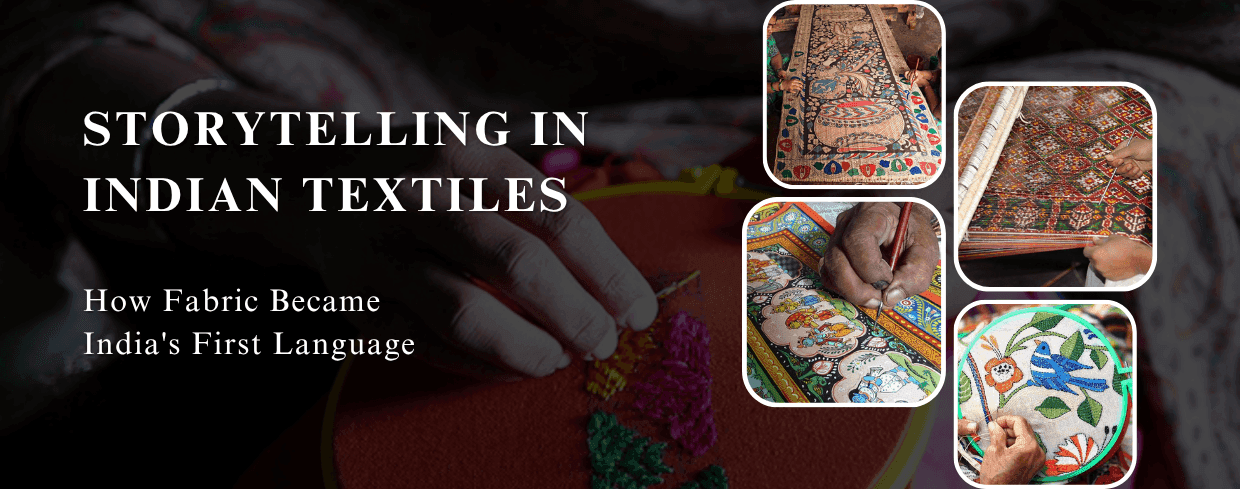
Long before fashion became a modern industry, Indian textiles were already carrying stories. A woven border, a painted motif or a line of stitches could express belief, memory and everyday life. Exploring Indian textile traditions is not just an exercise in nostalgia. It is a way of seeing how craft, culture and personal identity come together in cloth.
This blog explores five crafts, Kalamkari, Odisha Pattachitra, Phulkari, Kantha and Patan Patola, and the different kinds of stories they hold. It also looks at their place in contemporary wardrobes, what to consider before calling a textile sustainable, and how to wear heritage pieces without reserving them only for special occasions.
Kalamkari uses painting and block-printing traditions to bring motifs and narratives to cloth. Odisha Pattachitra is known for religious stories painted on prepared fabric. Phulkari connects embroidery with family and celebration, while Kantha combines stitching, memory and a history of reusing cloth. Patan Patola creates symbolic patterns through double Ikat, with both sets of yarn resist-dyed before weaving. These are related expressions of textile heritage, not a single technique: some are painted, others embroidered or woven. Their heritage alone does not establish a product’s environmental impact.
Before Fashion, There Was Storytelling
Cloth has served as more than clothing. Narrative hangings could accompany the telling of sacred stories; embroidered household textiles could preserve a maker’s relationships and memories. A textile might be useful, decorative and meaningful at the same time. Its story did not always need a written caption.
Reading that story takes context. A motif may relate to a religious narrative, a wedding tradition or simply the maker’s surroundings. Rather than assuming that every flower or border has one fixed meaning, ask where a piece was made, who made it and how it was used.
India’s textile map is vast, and each tradition has its own visual vocabulary. The five crafts below show how painting, embroidery and weaving can communicate in different ways, from a recognisable scene to a pattern associated with family life.
Kalamkari: Stories Painted in Cloth
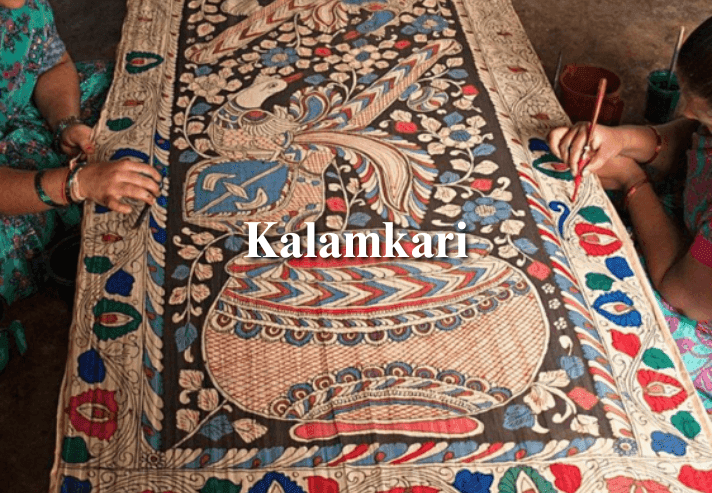
Artisans painting a large bird and floral motifs on cloth in an image labelled Kalamkari.
Kalamkari is closely associated with Andhra Pradesh, but its major traditions are not identical. Srikalahasti is known for freehand work using a kalam, or pen, while Machilipatnam Kalamkari is associated with wooden-block printing. The name combines kalam, meaning pen, with kari, meaning work or craftsmanship.
In narrative Srikalahasti cloths, scenes from sacred stories unfold across panels. Figures, floral borders and temple-inspired compositions guide the eye through the design. Some hangings accompanied oral storytelling, so the cloth was part of a performance rather than simply a decorated surface. This is where the connection between fabric and narrative becomes especially tangible. [1]
Traditional processes involve several stages of cloth preparation, dyeing and washing. Plant-derived dyes are part of that history, but “natural” does not automatically mean low-impact. The full process and its materials still matter when assessing a contemporary product’s sustainability.
Pattachitra: Sacred Stories on Cloth
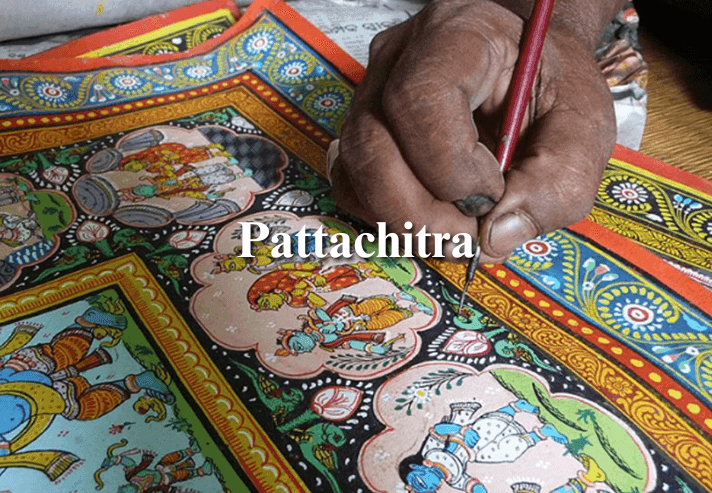
An artist painting detailed figures and ornate borders in a colourful Pattachitra composition.
Odisha Pattachitra is a painting tradition closely associated with Lord Jagannath and other religious narratives. Its name combines patta, a cloth or canvas, and chitra, a picture. The cloth is prepared to create a smooth painting surface; this is not simply a story of wall art later moving onto fabric.
Bold outlines, carefully arranged figures and ornate borders give the paintings their distinctive character. A composition may centre on a deity or bring several episodes together, inviting the viewer to follow the narrative through its details. The fabric supports a painting intended to be looked at closely, rather than functioning only as something to wear.
Pattachitra also appears in contemporary applications such as painted sarees. However, a traditional prepared-cloth painting and a wearable adaptation are not interchangeable. When buying a garment, ask about its materials, intended use and care rather than assuming that every painted textile behaves like ordinary fabric.
Phulkari: Stories Stitched by Hand
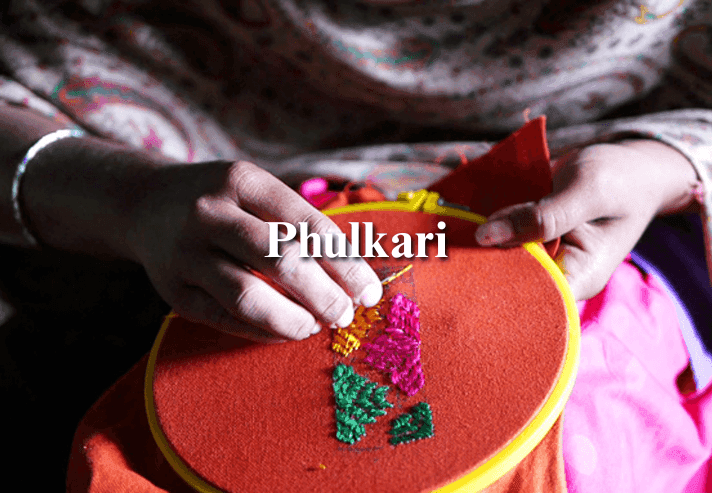
Hands embroidering pink, yellow and green shapes on orange fabric held in a yellow hoop.
Phulkari means “flower work” and belongs to the wider Punjab region, spanning parts of present-day India and Pakistan. Traditionally, lustrous silk thread is worked in darning stitches from the reverse of handwoven cotton cloth. Floral and geometric arrangements create the surface pattern.
Made within households, these embroideries are closely associated with women’s work and family occasions. Densely embroidered bagh textiles were important wedding coverings. Here, storytelling is not necessarily a sequence of illustrated events. Meaning can also come from the occasion for which a textile was made and the person who made or wore it.
That distinction matters when looking at heritage cloth. A piece does not need to depict a grand epic to carry a story. Time spent making it, the act of giving it and its place in a family can be just as meaningful as a recognisable figure stitched onto the surface.
Kantha: Memories in Every Stitch
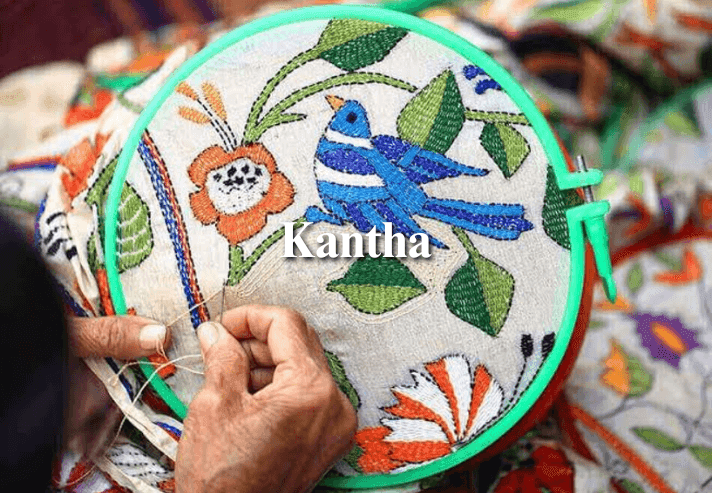
Hands stitching a blue bird, flowers and green leaves on pale fabric in an embroidery hoop.
Kantha belongs to Bengal’s shared textile heritage, including present-day West Bengal and Bangladesh. Worn sarees and dhotis were layered and joined with running stitches to make household textiles. Decorative stitching could then add motifs; the practical task of reusing cloth and the creative work were closely connected.
Historical Kanthas depict scenes from daily life, plants, animals and religious imagery. Some were made for family members or special occasions, giving them a personal significance beyond their function as covers or quilts. Looking closely at one can reveal the maker’s surroundings, relationships and imaginative world.
This history makes Kantha a useful example of textile reuse, but the name alone is not a sustainability guarantee. Contemporary products can use different combinations of new and reclaimed materials. Ask what the particular piece is made from, rather than assuming that every Kantha garment repurposes old cloth.
Patan Patola: A Story Woven Twice
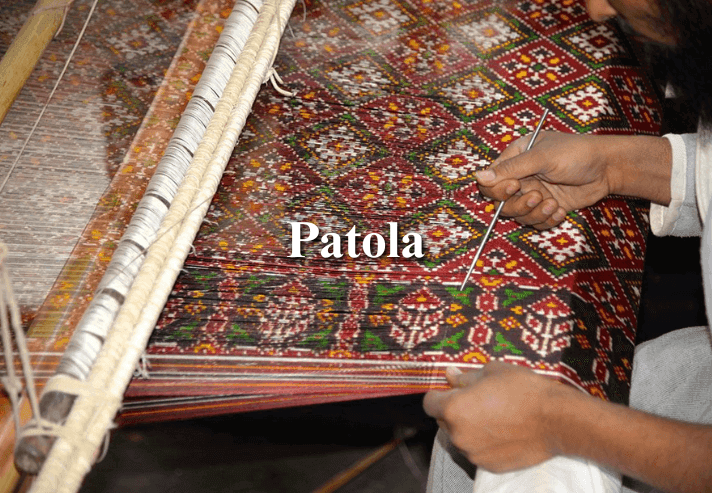
A weaver aligning threads to form a multicoloured geometric pattern on a handloom.
Patan Patola in Gujarat is known for double Ikat: both the lengthwise warp and crosswise weft yarns are tied and resist-dyed before weaving. The weaver must align the pre-dyed sections so that the pattern emerges through the cloth. Single-Ikat Patola traditions also exist in Rajkot and Surendranagar, so “Patola” should not always be treated as shorthand for the same technique.
An intricate Patan Patola can require many months of preparation and weaving, depending on the design and workshop. The demanding alignment is part of its value, but matching-looking front and back surfaces alone are not enough to establish a textile’s origin or making process.
Its storytelling also lies in the designs. Named patterns, known as bhat, can bring together flowers, birds, animals, human figures and geometric arrangements. Rather than illustrating an episode panel by panel, Patola can carry its associations through a repeated visual vocabulary and the occasions on which it is worn.
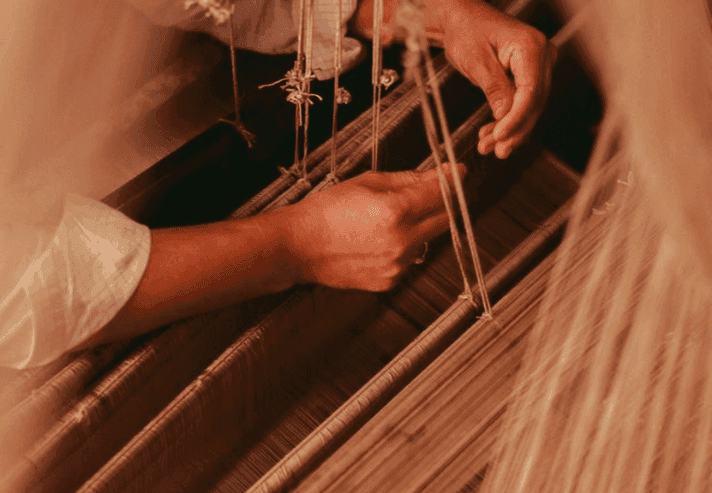
Close-up of a weaver’s hands working among the stretched threads of a handloom.
These five crafts offer a way to look beyond a garment’s colour or silhouette. A painted panel, an embroidered cover or a patterned weave holds evidence of decisions made during its creation. Understanding the technique helps us appreciate what we are seeing rather than treating every heritage-inspired design as interchangeable.
Environmental claims need the same care. Handmade production, natural dyes and a long history do not by themselves prove that a product is sustainable. Materials, processing, working conditions, durability and what happens after use all deserve attention. Reusing and caring for a piece you already own can be more useful than buying something new only because it carries a heritage label.
There is a livelihood question too. Choosing work from an identifiable artisan, cooperative or transparent seller can help direct demand towards the people practising a craft. Ask who made the piece, where it was produced and what technique was used. A printed reproduction of a motif does not necessarily support the same making skills as a traditionally crafted textile.
How Designers and Artisans Keep the Story Alive
These textiles are not frozen in history. A Kalamkari blouse or a Kantha-embroidered jacket can sit comfortably alongside contemporary cuts. For more on the relationship between regional craft and modern clothing, explore Indian textiles on global runways.
Reinterpretation, however, is not automatically preservation. Using a familiar motif is different from commissioning the original painting, embroidery or weaving technique. Crediting the craft and maker, explaining the process and asking how artisans are involved make the distinction clearer.
As a wearer, keeping a piece in use is a practical place to start. Look for ways to style clothes you already own, repair them when appropriate and learn their care needs. The story continues through use and attention, not only through another purchase.
For modern wardrobes, the challenge is often not appreciation but application. How do you wear an embroidered dupatta or a richly patterned saree without feeling that every part of the outfit must be equally elaborate?
A useful starting point is one focal piece. Pair a Kalamkari blouse with tailored trousers, a Phulkari dupatta with a minimal kurta set, or a Kantha-embroidered jacket with plain denim. The simpler pieces give the painting or stitching room to stand out. These are styling options, not rules about how heritage clothing must be worn.
To bring the look together, build a colour palette around one motif: choose a shade already present in the textile and repeat it in a plain blouse, bottom or accessory. Check the fabric’s weight and drape as well as its pattern. A light stole and a structured jacket will need different combinations even when their colours are similar.
BeSpoke AI Stylist can help you explore outfit combinations around pieces in your wardrobe. Start with the heritage garment, then consider what you already have to wear with it. Styling tools can help with combinations; information about a textile’s origin and technique still needs to come from its maker or a reliable source.
What is the difference between Kalamkari and Pattachitra?
Kalamkari includes Andhra Pradesh’s pen-work and block-printing traditions, using processes that dye the cloth. Odisha Pattachitra is painting on a specially prepared cloth surface, often with bold outlines and religious subjects. Both can tell stories, but their materials and processes are different.
Why is Patan Patola considered so valuable?
Patan Patola combines fine materials with the precision of double Ikat. Both yarn systems must be resist-dyed to a planned design and aligned during weaving. This can take months; complexity, materials and workmanship influence the value of a particular piece.
Is Kantha embroidery sustainable?
It can involve textile reuse, but not every Kantha product is made from reclaimed cloth. Check the actual materials and production information. Its history of repurposing garments is meaningful, but sustainability depends on the particular item and how it is made, used and cared for.
How can I style traditional Indian textiles in everyday outfits?
Start with one piece you enjoy wearing, such as a patterned blouse, embroidered jacket or dupatta. Pair it with comfortable, simpler separates, repeat a colour from the textile and choose accessories that suit the occasion. The aim is to make the piece part of your wardrobe, not leave it waiting for a perfect event.
Storytelling in Indian textiles takes many forms. Kalamkari and Pattachitra can present recognisable narratives; Phulkari and Kantha can carry family connections; Patan Patola brings meaning into the planning and repetition of a woven design. Their differences are part of what makes this heritage worth learning about.
Knowing a little more about a piece changes the questions we ask of it: Who made it? What does the motif mean in its context? How should it be cared for? A thoughtful wardrobe can make room for those stories while keeping the clothes themselves useful, personal and regularly worn.
Sources and Further Reading
https://aims.vmis.in/caa-exhibitions/kalamkaris-of-srikalahasti/. Narrative cloths, temple imagery and the pen-dyeing process.
https://krishna.ap.gov.in/one-district-one-product/. The block-printing tradition and its distinction from Srikalahasti Kalamkari.
https://utkalikaodisha.com/gi-product-pattachitra/. Prepared-cloth painting, Jagannath narratives and contemporary applications.
https://www.vam.ac.uk/articles/indian-embroidery. Phulkari and Kantha materials, stitches and regional contexts.
https://press.philamuseum.org/a-century-of-kanthas-womens-quilts-in-bengal-1870s1970s/. Household textiles, reuse, family connections and narrative imagery.
https://gujarattourism.com/handicrafts/patola.html. Patan double Ikat and the single-Ikat traditions of Rajkot and Surendranagar.
https://www.patanpatola.com/technique.html. An artisan account of resist-dyeing, alignment and production time.
https://www.patanpatola.com/products.html. Named designs and their floral, animal, human and geometric motifs.
https://www.unep.org/topics/chemicals-and-pollution-action/circularity-sectors/sustainable-and-circular-textiles. A life-cycle perspective on textile production, consumption and environmental impacts.
Written by BeSpoke AI Stylist Editorial Team
Published: 01/08/2026
Last updated: 01/09/2026
Ready to upgrade your style game? Download BeSpoke AI Stylist and let your AI stylist take it from here.

Author
Neeraj Bansal