The Right Necklace for Every Neckline: A Festive Styling Guide
Published · Updated
The festive outfit is ready, but the necklace you had in mind lands directly on the blouse border. Shortening it makes it uncomfortable. Leaving it long hides the detail you chose the blouse for. Before buying a replacement, put the whole outfit on and look at where the necklace needs to sit.
Use your neckline as a starting point. Our broader neckline and jewellery pairing guide covers different styling directions. Here, the question is more practical: how do you make a necklace work with a festive blouse or kurta, especially when embroidery and a dupatta are involved?
At a Glance
- Square neckline: Try a choker that leaves the square edge visible, without tightening it to force the position.
- Off-shoulder neckline: A short single strand of pearls is one option when you want space between the necklace and the garment.
- Open collar: Try a pendant inside the opening, with its lowest point clear of the fastening you want to show.
- Scoop neckline: Start with two necklaces at different lengths and check that the lower one stays above the neckline for this arrangement.
- Before choosing: Put on the dupatta and move normally. An uncomfortable necklace is not worth keeping in the outfit just to follow a pairing rule.
Begin With Where the Necklace Ends
Look at the lowest point of the jewellery, including a pendant or decorative drop. Does it sit on skin, lie across fabric, or repeatedly slip behind the neckline?
For the arrangements below, the aim is to keep the necklace visible above the garment edge. This is an option to try, not a ban on long necklaces worn over clothing. A long necklace over a plain kurta can be a deliberate choice. A pendant that keeps disappearing behind a decorated border is a different problem.
Fasten the blouse as you intend to wear it. Arrange the pallu or dupatta before deciding how much room is available. A low neckline on an uncovered blouse may look quite different once part of it is draped.
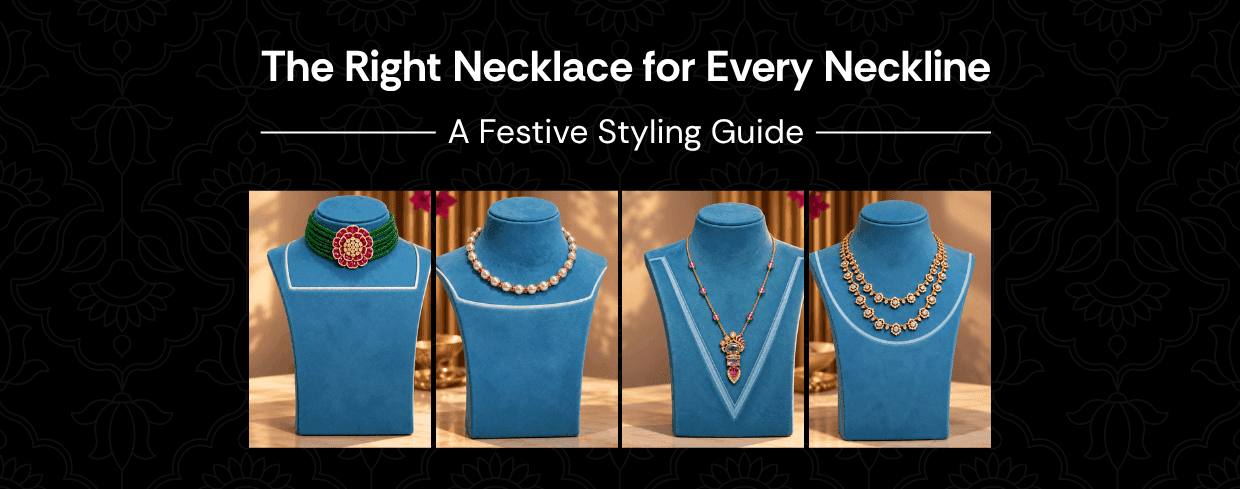
The illustrations use display busts with neckline guides. They show placement ideas, not scale measurements or proof that a particular necklace will fit you. The garment examples below are suggestions to try with your own clothes.
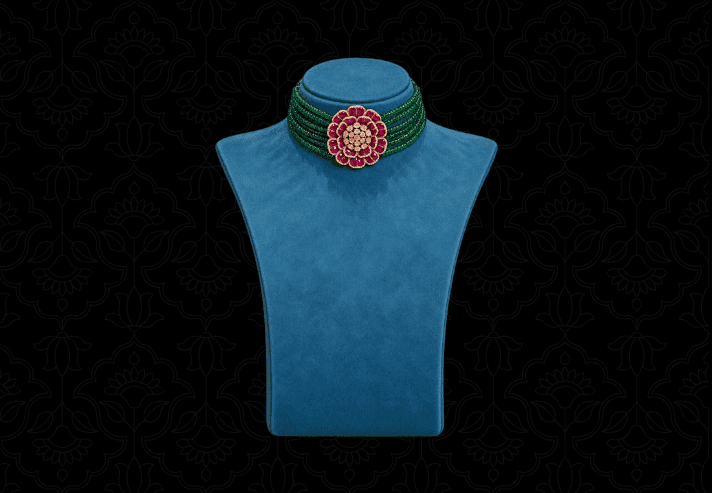
A short necklace leaves the square outline visible in this placement illustration.
A square-neck saree blouse gives you a clear lower edge to work around. Try a short choker whose lowest decoration finishes above that edge. Look at the central motif as well as the band: the band may sit high while a hanging detail reaches the blouse.
For a festive dinner, try a wine-red square-neck blouse with a cream saree. A green-beaded choker offers a colour contrast; a short necklace you already own in a quieter colour is another starting point. Put on the earrings last so you can decide how much detail you want near the face.
The necklace does not need square-shaped stones to work with a square neckline. Its position is more useful to assess than a supposed requirement to match shapes.
When the choker overlaps the blouse border:
- Use its intended adjustment. Try another fastening position only when it remains comfortable. Do not keep tightening it to produce a gap.
- Compare a shallower design. A narrower necklace may leave the border visible when a broad centrepiece does not. Earrings without a necklace are another option.
Prefer the necklace to the blouse? Try it with a deeper neckline already in your wardrobe, provided that is the coverage you want. There is no need to alter your body or accept an uncomfortable fit to reproduce a photograph.
For colour ideas, you can build an outfit palette around an existing reference. Use a bead colour you enjoy without assuming that a green stone is an emerald.
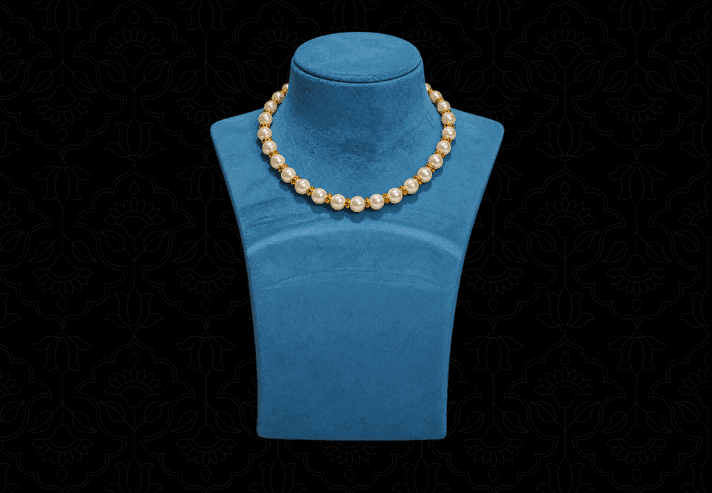
A short strand with space above the garment line. The pictured beads are not authenticated pearls.
With an off-shoulder blouse, a short pearl strand gives you one curved line above the garment. Try it with a midnight-blue off-shoulder blouse and a full skirt in a similar shade. Keep the strand on while you arrange any wrap you intend to wear.
Look at the gap while standing normally. You do not need to lower your shoulders or hold your head in a particular position to make the necklace look right. Raise your arms, then let the garment settle again. The neckline may not return to exactly the position it held in your first photograph.
A pearl strand does not have to be plain to count as a single strand. Small spacers can be part of the design. The useful feature here is one visible row, rather than several layers occupying the opening.
When the neckline itself has a ruffle or heavy decoration:
- Compare a smaller strand. Check whether it gives you the separation you wanted without resting on the trim.
- Try earrings alone. An open neckline does not create an obligation to fill the space.
Pearls and pearl-look jewellery can both be used to explore this appearance. The styling choice does not establish their value or composition. GIA's pearl identification services distinguish material characteristics through examination, rather than treating a photograph as authentication.
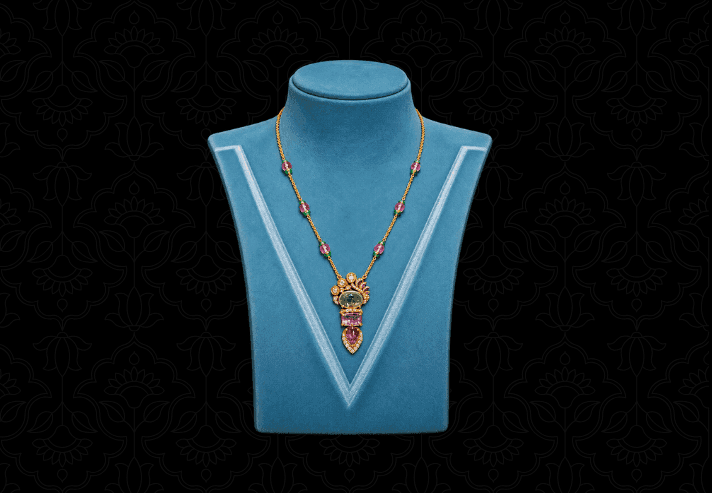
The V-shaped guide represents the opening below a collar; it is not a photograph of a collared garment.
Try a pendant with an ivory collared kurta and dark straight-leg trousers for a festive gathering. Open only the fastenings you are comfortable leaving undone. Then choose a chain setting that lets the pendant sit within that opening.
Check the entire pendant. The chain may appear short enough while the decorative drop reaches the first closed button. A longer pendant needs more vertical space than a small charm on the same chain.
Sit down and lean forward slightly. Does the pendant catch under the collar or disappear behind the placket, the strip where the buttons fasten? Try a shorter compatible chain when that is an option. Keep the collar coverage you prefer rather than undoing another button solely for the necklace.
A pendant can also sit outside a closed shirt as a separate styling choice. That is not the inside-the-collar arrangement illustrated here, so judge it on its own terms. Start over a plain section of fabric where you can see the whole design.
For an inherited pendant, avoid transferring it to a fine chain without checking compatibility. Ask a jeweller whether the chain and fastening are suitable for that pendant before wearing it out.
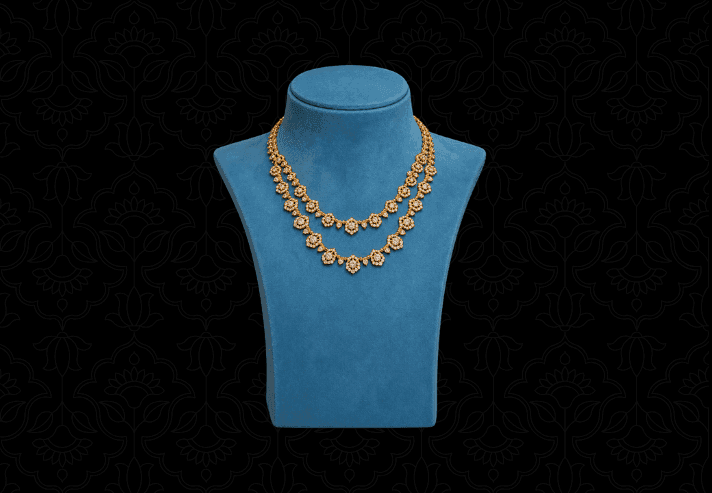
Different lengths keep both necklace rows visible above the curved guide.
Start with two necklaces over a plain scoop-neck blouse. Put on the shorter one first, then add the second. For this arrangement, keep the lower necklace above the scoop so its decoration does not merge with the blouse edge.
Try a deep green scoop-neck kurta with cream trousers. Two gold-toned chains can provide the layered effect without requiring the large decorative necklaces in the illustration. Add your dupatta before deciding whether there is still enough visible space.
Do not choose the gap from a fixed number of centimetres. Look at the size of the pendants and whether the rows remain separate when you move. Two chains with different listed lengths may still put their lowest decorations in the same place.
When the necklaces keep overlapping:
- Adjust one length. Use the necklace's own extender or a compatible option recommended for it. Check both fastenings afterwards.
- Remove one layer. A single necklace may suit the opening better. Different lengths do not guarantee that chains will never tangle.
A ready-made multi-row necklace is another possibility when you already own one. Inspect it as a single piece and follow its own care instructions. Do not assume separate chains can be attached together safely to imitate it.
Check the Dupatta Before Leaving
An outfit can look right from the front while the jewellery catches on fabric as you turn. Put on the dupatta in the drape you intend to use, rather than simply holding it beside the necklace.
Look for contact between the fabric and the necklace's settings. Inspect the clasp at the back as well. Do not drag a delicate dupatta across jewellery to test it, or pull against a snag to make the cloth release. Stop and separate them gently; get help when you cannot see the caught area.
The guide to mixing textures in an outfit offers other fabric comparisons. For jewellery, the immediate decision is whether the materials can sit together without repeated catching.
With a heavily embroidered neckline, compare the outfit without a necklace before adding more. You may prefer earrings and leave the embroidery visible. Someone who enjoys a fuller jewellery look can make a different choice, but the physical contact still deserves attention.
Measure the Necklace
A listing that says “18 inches” does not tell you where a necklace will end on your body. As Pandora's necklace size guide explains, you can use an existing necklace as a reference and measure its full length from clasp end to clasp end.
Put that reference necklace on with the blouse first. Note the fastening position that works. For a new purchase, ask how the seller measures the piece and whether the stated length includes the extender. Ask separately about the pendant's drop.
A broad beaded choker is not interchangeable with a flexible fine chain of the same listed length. Try the actual design when possible. Do not assume adding length will fix a necklace that is rigid in a shape you find uncomfortable.
Before You Buy, Ask What Is Actually Being Sold
A styling guide can help you choose an appearance. It cannot confirm metal purity or identify a gemstone from a photograph.
- Ask about composition. Request the base metal and any plating details in writing. “Gold-toned” describes appearance, not a verified gold content.
- Ask about dimensions. Confirm the wearing-length range and the size of any hanging decoration.
- Read the terms. Check the seller's return or exchange conditions before paying, especially for customised pieces.
- Keep the evidence separate. When considering hallmarked gold jewellery in India, use the Bureau of Indian Standards' HUID verification guidance. That is a gold-hallmark check, not a styling score or a pearl-identification service.
These questions are useful even when you decide not to buy. A compatible adjustment to jewellery you already own may be the only change needed.
Comfort and Care Are Part of the Decision
Remove a necklace that causes itching or a rash. The American Academy of Dermatology's nickel-allergy guidance explains why jewellery can be a source of exposure. Seek advice for a persistent reaction rather than treating it as the cost of wearing the outfit.
For cultured pearls, GIA advises wiping them with a very soft, clean cloth after wear and avoiding ultrasonic or steam cleaners. Its pearl care guide explains the precautions. Follow item-specific instructions for imitation beads or pieces combining several materials; one cleaning method is not suitable for every necklace.
Frequently Asked Questions
What necklace can I wear with a square-neck blouse?
Try a short choker that leaves the square edge visible. Check its lowest decoration, not just the band. A smaller necklace or earrings alone may work better when the border is high or heavily decorated.
What necklace goes with an off-shoulder outfit?
A short single strand of pearls is one option. Try it with the garment in its normal position and compare the result without a necklace. Your preference matters more than filling the space.
Should every necklace stay above the neckline?
No. This guide uses above-the-edge arrangements to keep the jewellery and neckline separately visible. Long necklaces over fabric are another styling direction. Check whether the necklace stays visible and comfortable in the position you choose.
Can I mix silver-toned and gold-toned necklaces?
You can try mixed finishes when you like the result. Start with the pieces you have and check how they sit together. Matching finishes do not solve overlapping pendants or uncomfortable weight.
Can an AI preview tell whether a necklace will fit?
A visual preview cannot establish exact wearing length or physical comfort. It also cannot verify jewellery materials or prove that a setting will not snag fabric. Use it as an outfit reference, then check the real pieces.
Keep the Combination That Works
Take a photograph once you like the outfit. Include the dupatta in its final position and note which fastening you used. This gives clothes you already own a repeatable accessory choice for another occasion.
For help planning the clothing around your chosen jewellery, explore outfit planning with your own virtual avatar in BeSpoke AI Stylist. Keep a real reference photo of the necklace beside any preview. Check the actual jewellery with the outfit before wearing it out.
Sources and Further Reading
Ready to upgrade your style game? Download BeSpoke AI Stylist and let your AI stylist take it from here.

Author
Neeraj Bansal