
Your Next Fashion Idea Could Come From Anywhere
Published · Updated
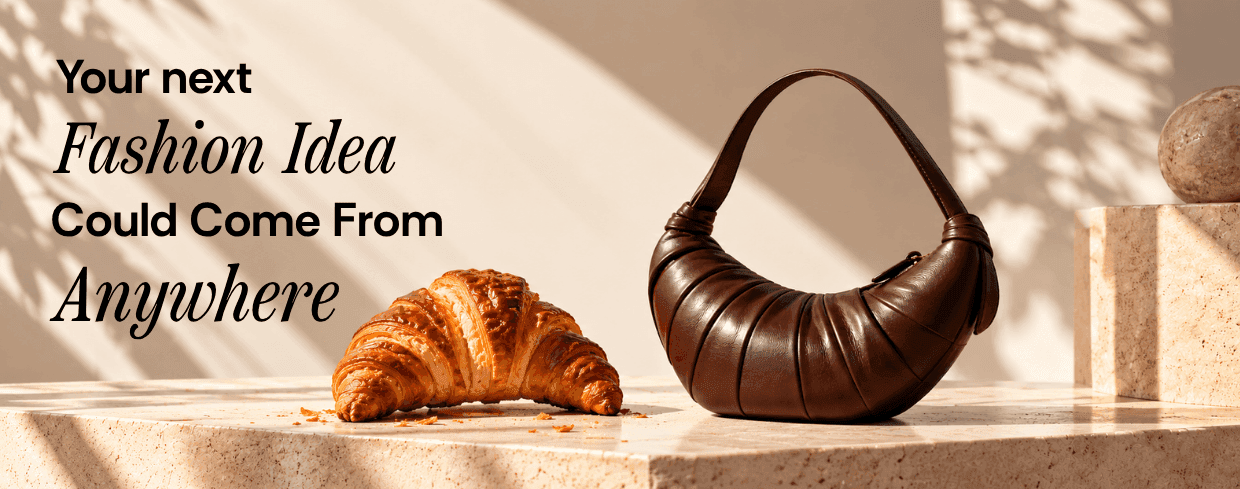
A croissant arrives beside your coffee. You notice the curve before breaking it open. Later, a silver bag with a ridged surface reminds you of a shell you once kept on a windowsill. Neither moment began with someone telling you what to wear.
Fashion inspiration from everyday objects starts with that small act of noticing. Something catches your eye, and you work out which part you want to carry into an outfit. It gives you another way to style clothes you already own, especially when your saved looks have started to resemble one another.
The eight examples below move from a pastry to a bag of oranges. Some connections are documented by a designer or museum; others are visual comparisons we are making. You can use either as a starting point for your own idea, without confusing resemblance with the story of how a product was designed.
Quick answer: You can find fashion inspiration in everyday objects by noticing one specific detail, such as a curve, a texture, a colour or a shine, and carrying it into an outfit. A croissant can suggest a curved bag, a shell can suggest pleats, and crumpled foil can suggest a metallic skirt. Start with clothes you already own.
At a Glance
- Name the detail that caught your eye. “A curved edge” gives you more to work with than “I like this”.
- Choose what to borrow. You might keep a colour while leaving the object's shape behind.
- Look in your wardrobe first. An existing pleated skirt can answer a shell reference without a new shell-shaped bag.
- Change the scale. A metallic earring is a smaller way to explore shine than a full silver outfit.
- Keep the reference, not a requirement to copy it. The finished look only needs to make sense to you.
A Croissant Can Get You Thinking About Curves
LEMAIRE's Large Croissant Bag in Dark Chocolate makes the connection unusually clear. The brand describes its curved shape as inspired by the pastry, with stitched panels helping create the form.
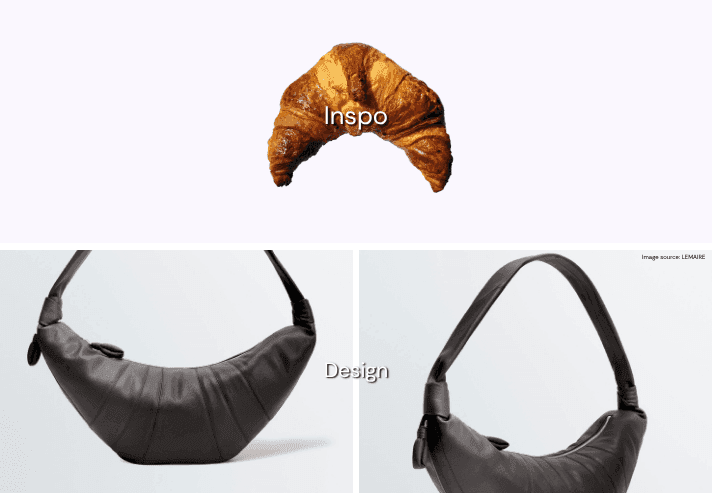
Large Croissant Bag in Dark Chocolate by LEMAIRE. Both fashion images sourced from LEMAIRE’s official website.
Look at the two side by side. The useful detail is not simply that both are brown. It is the way a broad middle tapers towards the ends, with divisions across the surface. You could notice that outline even in a black-and-white photograph.
For your own outfit, try a curved shoulder bag with a straight-cut shirt and trousers. The clothes give the bag's outline room to remain visible. A bag you already have with a rounded body is enough to test the idea.
You could take a completely different route and use the pastry's colours instead: a pale top with darker brown trousers. That would still be your interpretation of the reference. You are deciding what interested you, rather than treating the object as a list of features to reproduce.
A Shell Offers More Than a Beach Theme
A shell has lines that spread from a small point towards a wider edge. Cult Gaia describes its Nala Mini Clutch in Silver as shell-shaped, making this another connection supported by the product's own description.
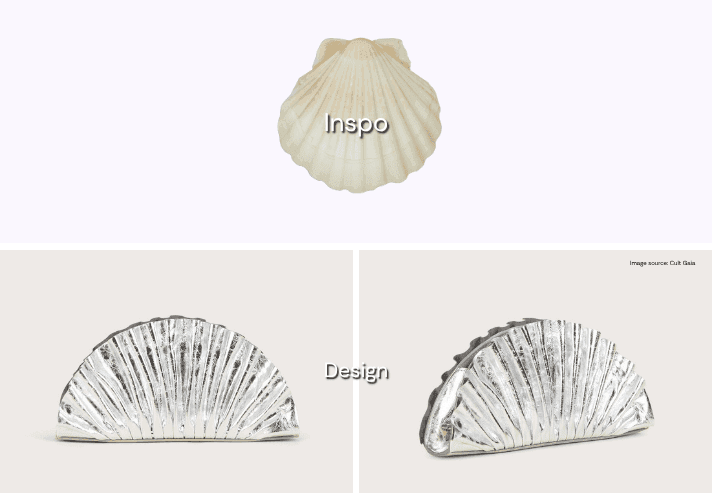
Nala Mini Clutch in Silver by Cult Gaia. Both fashion images sourced from Cult Gaia’s official website.
The silver finish changes the colour completely while the fan-like shape remains recognisable. That is a useful reminder: a reference does not have to keep its original palette to survive the translation.
Try a pleated skirt with a plain shirt. You are borrowing the repeated ridges rather than searching for an accessory shaped like a shell. Put the shirt on with the skirt and see how much of the pleating you want visible above the hip.
Alternatively, keep the shell's pale colouring and choose a cream outfit with a small reflective accessory. Our guide to building an outfit colour palette from a visual reference offers another way to develop that choice.
The outfit can be for an ordinary afternoon. Finding inspiration in a shell does not oblige you to dress for the seaside.
A Durian Makes Texture Hard to Ignore
The spikes on Chet Lo's Heavenly Gradient Polo make the durian comparison easy to see. There is also a documented connection: in his interview with The Zoe Report, Lo recalled noticing that the spikes he was making reminded him of the fruit. That is more precise than saying a durian was the single origin of the technique.
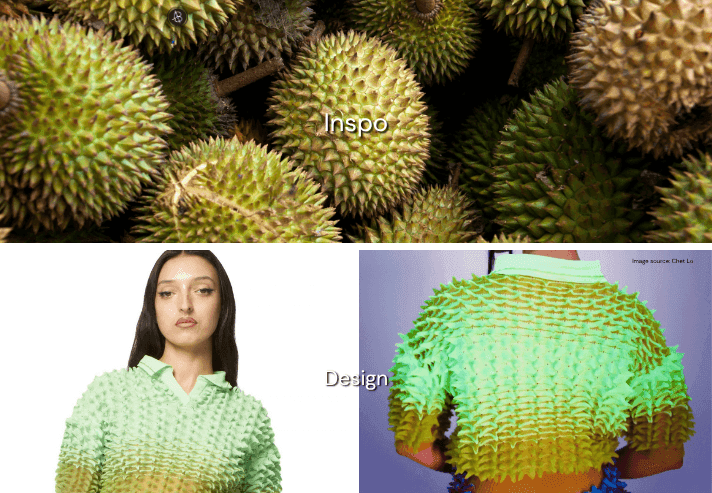
Heavenly Gradient Polo by Chet Lo. Front image sourced from The Zoe Report. Back image sourced from Chet Lo’s official 2nd Generation collection archive.
For an outfit you can wear now, look for a raised surface you already own. A bobbled cardigan over a smooth top lets you explore that difference without needing the pictured knit. Wear it with your usual trousers first and decide whether the texture is the part you enjoy.
You might instead be drawn to the polo's green gradient. A pale green shirt with a darker green bag would borrow that relationship without repeating the spikes. Our guide to mixing textures in an outfit can help when the surface is what interests you most.
There is another good detail in Lo's 2nd Generation archive: its references include a faulty laptop screen. Even an interruption can become something worth looking at.
A Balloon Can Suggest Volume in a Small Space
Beside a pink balloon, LOEWE's Inflated Cat-Eye Sunglasses invite an immediate comparison. Both have a rounded, expanded appearance. The Mytheresa listing preserved on Endource identifies the pink style; the balloon pairing here is our visual reading, not a claim about its documented origin.
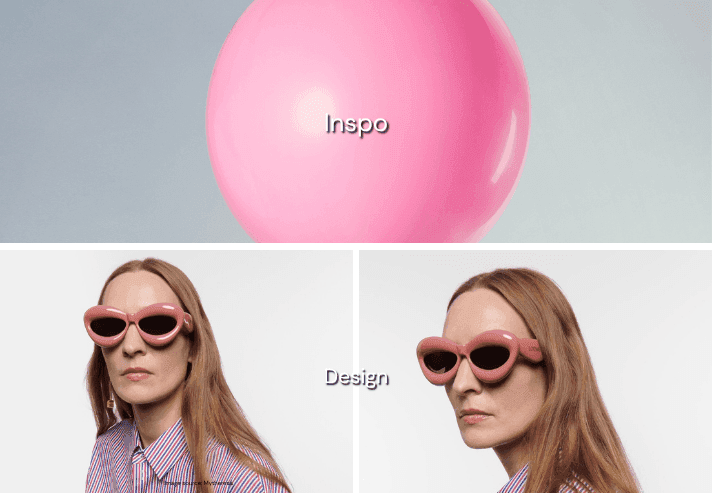
Inflated Cat-Eye Sunglasses in Pink by LOEWE. Front image sourced from Mytheresa. Three-quarter image sourced from Mytheresa via Endource.
What might you borrow? Perhaps it is the size of the frame, or the pink sitting against a quieter background. You can separate those ideas.
Try a rounded pink bag with a white shirt and dark trousers. Then compare a smaller pink accessory. The colour stays similar while the amount of it changes.
A gathered sleeve offers another way to explore rounded volume without adding a new accessory. It need not be pink at all. Keep the outfit within the coverage and setting you prefer, and let the reference help you make a choice rather than dictate the entire look.
A Spoon Can Be a Reference for Shine
A polished spoon and Bottega Veneta's Small Drop Earrings in Silver share a smooth, curved surface. Light moves across each in broad reflections rather than a scatter of tiny sparkles.
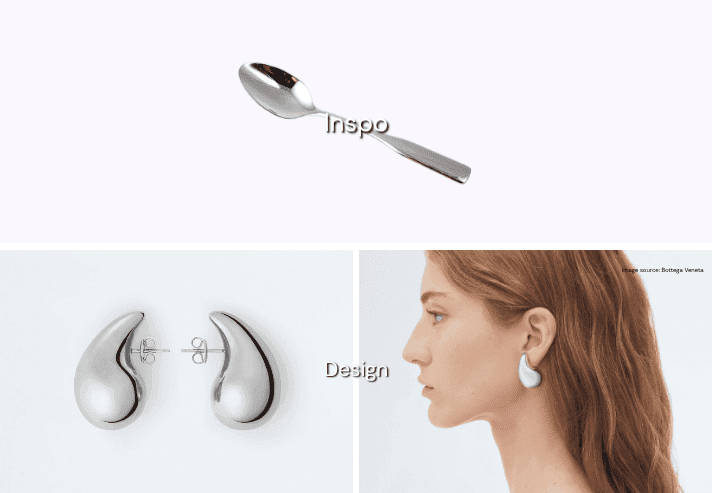
Small Drop Earrings in Silver by Bottega Veneta. Both fashion images sourced from Bottega Veneta’s official website.
This is a comparison of finish and form. It does not establish that the earrings were designed from a spoon.
For a smaller wardrobe experiment, wear smooth silver-toned earrings with a dark, unpatterned top. Compare them with a textured pair, keeping the clothes unchanged. You are checking which kind of shine appeals to you.
Put on any necklace you usually wear too. You might like both together, or decide the earrings provide enough detail. The neckline and jewellery guide offers combinations to compare, rather than a reason to replace what is already in your jewellery box.
An ordinary kitchen object can help you describe a finish. It does not need to become a literal accessory.
Crumpled Foil Can Suggest a Different Kind of Silver
Now put that smooth spoon beside crumpled foil. The colour family is similar, but the broken surface catches light in a different pattern.
That is the connection we are drawing to Rabanne's Ruched Metallic Midi Skirt in Silver. The gathered fabric gives the reflective finish changes of direction. This is a visual analogy, not a claim that the garment is made from kitchen foil or was inspired by it.
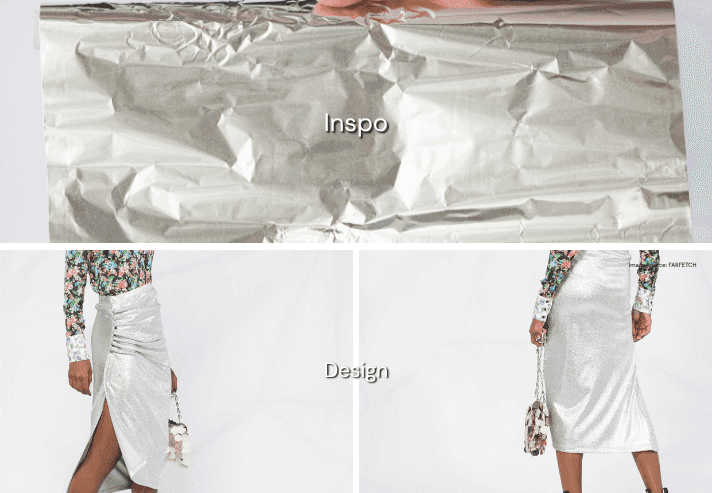
Ruched Metallic Midi Skirt in Silver by Rabanne. Both fashion images sourced from FARFETCH.
Try a metallic skirt with a plain T-shirt and footwear you already wear. The T-shirt gives you an everyday starting point while you decide how much shine you enjoy.
For evening plans, compare a dark long-sleeve top with the same skirt. There is no need to change every part of the outfit. The source photograph pairs the skirt with a floral blouse and boots, which is a different direction again.
When a full skirt feels like too much, keep the reflective idea in a small bag. The useful distinction is the finish you want to see, not the size of the purchase.
A Paper Lantern Can Change How You Look at a Skirt
Issey Miyake's Minaret Dress, 1995, introduces a more sculptural possibility. The Powerhouse Collection record, 95/143/1, discusses the dress in relation to a folded paper lantern and records internal metal hoops supporting its shape.
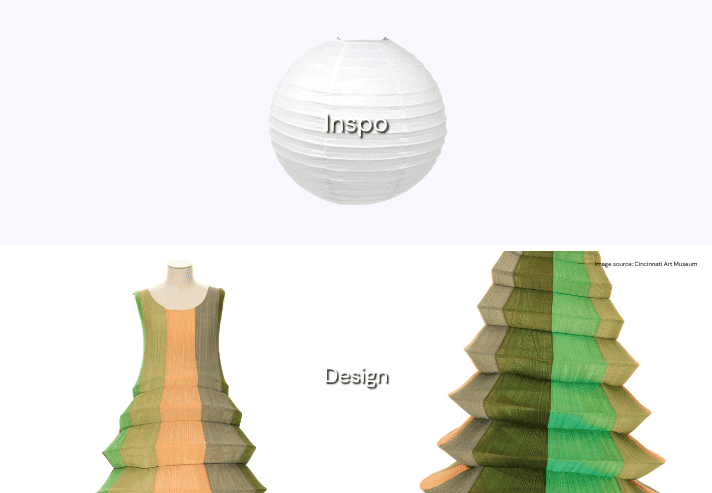
Minaret Dress, 1995, by Issey Miyake. Both fashion images sourced from Powerhouse Collection, museum collection reference 95/143/1. Purchased 1995.
You can see why the comparison holds: the dress expands in tiers rather than falling in one uninterrupted line. This is a documented museum interpretation, not a story inferred only from the two photographs.
You do not need to reconstruct the dress to use the idea. Try a tiered skirt with a plain top and notice the outline from the side. Or choose a pleated garment and pay attention to what happens as the folds open when you move.
A lantern can also suggest colour placement. The dress combines vertical bands with a wider outline lower down, giving you more than one detail to consider.
Choose the one you would enjoy wearing. A smaller amount of volume is still a valid response to a large sculptural reference.
A Bag of Oranges Can Send You Back to an Old Tote
The last comparison is between oranges held in a net and Prada's Mini Crochet Tote Bag in Orange. The orange colour and open structure make the connection visible.
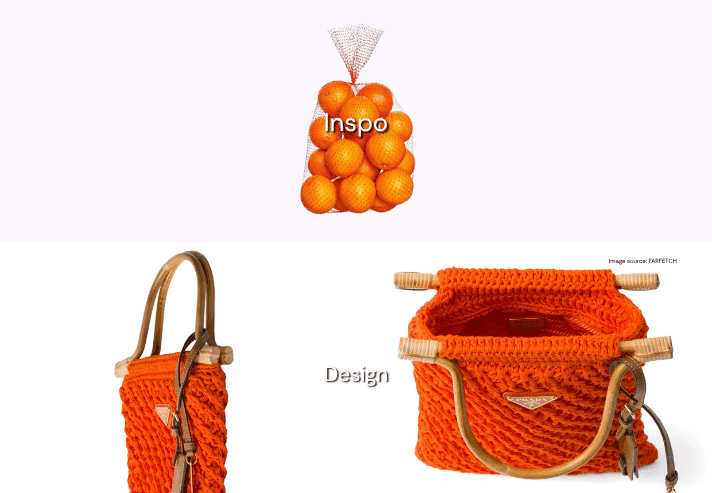
Mini Crochet Tote Bag in Orange by Prada. Both fashion images sourced from FARFETCH.
They are not the same construction, and we are not presenting the fruit packaging as Prada's confirmed source. The pairing helps isolate two things you might want to borrow: the bright colour, or the spaces between the threads.
Try an openwork tote with a plain top and jeans. Use a suitable inner pouch for small belongings rather than assuming the gaps are only decorative.
For a festive outfit, an orange bag could sit beside a cream kurta you already own. Or leave the orange out and try a neutral crochet accessory instead. That keeps the open surface while changing the palette.
You may find the relevant item has been in your cupboard for years. Looking at it beside a different reference can be enough to give it another outfit.
Turn the Thing You Noticed Into Something You Can Wear
The designer examples are useful, but your own reference does not need a famous name attached to it. Photograph something that catches your eye, or write a brief note when taking a picture is not appropriate.
Then make the observation usable:
- Describe one detail. “Orange behind an open grid” is a workable note. “Interesting market photo” leaves the next decision unclear.
- Choose where it will appear. Keep it in an accessory, or let a garment carry it.
- Find a familiar starting piece. A shirt you already wear gives the new idea somewhere to go.
- Try the whole outfit. Check movement and any dress code before saving the version you like.
For example, a silver shutter might lead you to a ribbed grey top rather than a metallic skirt. An orange awning might suggest a scarf against navy clothing. These are proposed exercises, not references for the products above.
You can use Try On with your virtual avatar for an outfit preview when you want another way to compare your clothes. Check the real pieces afterwards; a preview cannot establish their exact fit or material behaviour.
Put an Unmade Idea Into Words
Sometimes the detail suggests an outfit you do not own. Designer in BeSpoke AI Stylist lets you explore a written idea as a visual concept. The Designer guide explains the feature separately from styling your existing closet.
Here is an original starting prompt based on the shell's ridges rather than an exact copy of the clutch:
Design an ivory midi skirt with narrow fan-like pleats, worn with a plain navy short-sleeve top and silver flats. Keep the skirt opaque and the shoes visible in a full-length view. No shell print or logos.
Read the result beside the prompt. Check whether the pleats remain the main idea and whether the coverage is what you requested. A concept is not a finished garment or a sewing pattern.
Frequently Asked Questions
Where can I find fashion inspiration outside social media?
Begin with something you already notice in daily life. A market stall can offer a colour reference; a building detail can suggest a shape. Choose one specific feature and look for a way to use it in clothes or accessories you own.
How do I turn an object into an outfit idea?
Describe the part that interests you, then choose a garment or accessory that can carry it. A lantern might lead to a tiered skirt. You do not have to dress as the object or reproduce every feature.
Were all these designs inspired by the objects shown?
Highly likely.No, not all of them. LEMAIRE names the pastry connection, Cult Gaia calls the Nala shell-shaped, and Chet Lo has spoken about the durian resemblance. Powerhouse discusses the Minaret Dress in relation to a paper lantern. The other four pairings here are visual comparisons, not verified accounts of design origins.
Do I need to buy the designer pieces to try the idea?
No. The point is to identify a detail you can work with. A curved bag or a textured top you already own may give you somewhere to begin.
Can AI help me turn an inspiration into an outfit?
Yes. Describe the detail you noticed, such as “narrow fan-like pleats in ivory”, and Designer in BeSpoke AI Stylist turns it into an outfit concept. Use the concept to explore the idea, then check what you already own before buying anything.
Keep Your Next Reference
The next thing that catches your eye might be on the breakfast table rather than a runway. Keep a picture or a few words about it. Then see which part you would enjoy wearing.
You do not have to find the whole outfit at once. A curve is enough to start.
Ready to try it? Add the pieces you already own to Closet in BeSpoke AI Stylist and plan the outfit there. Download BeSpoke AI Stylist on the App Store or Google Play.
Sources and Further Reading
Ready to upgrade your style game? Download BeSpoke AI Stylist and let your AI stylist take it from here.

Author
Neeraj Bansal